INFOGRAPHICS. Registrations for new heavy goods vehicle over 3.5 tonnes have declined for the second consecutive year in Europe in 2025. The electric vehicle market remains comparatively modest but is progressing.
1/European market
Registrations of vehicles over 3.5 tonnes in the European Union fell by 6.2% in 2025 compared to the previous year, according to ACEA data. With 307,460 units registered, the market confirms a downward trend that began in 2024 (-6.3%).
Vehicles over 16 tonnes represent 83% of the European market, with 254,488 registrations (-5.4%). The market for vehicles from 3.5 to 16 tonnes suffered a more marked decline (-9.9%, 52,972 registrations). If we include the United Kingdom, Switzerland, Norway and Iceland, the number of heavy goods vehicle registrations in Europe reached 371,240, down 5.4%.
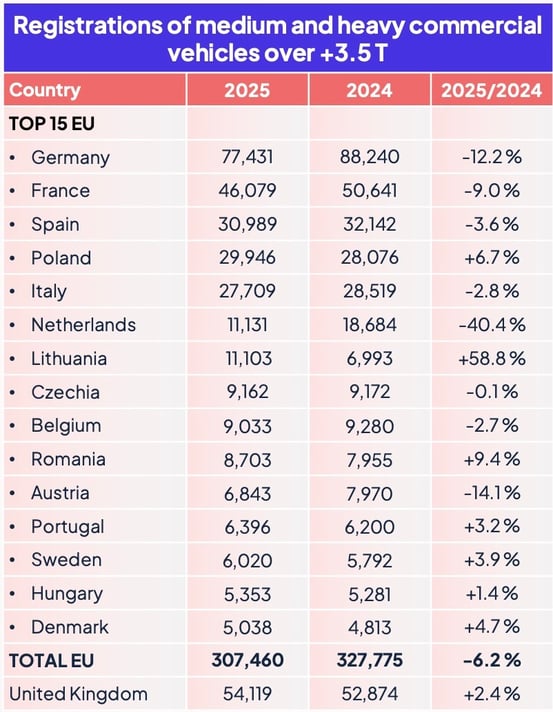
Table 1 - Data source: ACEA - © Upply.
After two years of strong post-Covid recovery, road freight transport has been hit hard by the slowdown in the European economy. This is undoubtedly the primary factor explaining the market downturn. Companies' profit margins are tending to shrink, which hinders their capacity to make investments. The slow drop in borrowing rates has not been enough to reverse the trend.
Long-term analysis shows an even more worrying development: beyond cyclical reversals, there is a downward trend in the market. Between 2019 and 2025, registrations of new heavy goods vehicles experienced an average annual decline of 1.2% in the European Union.
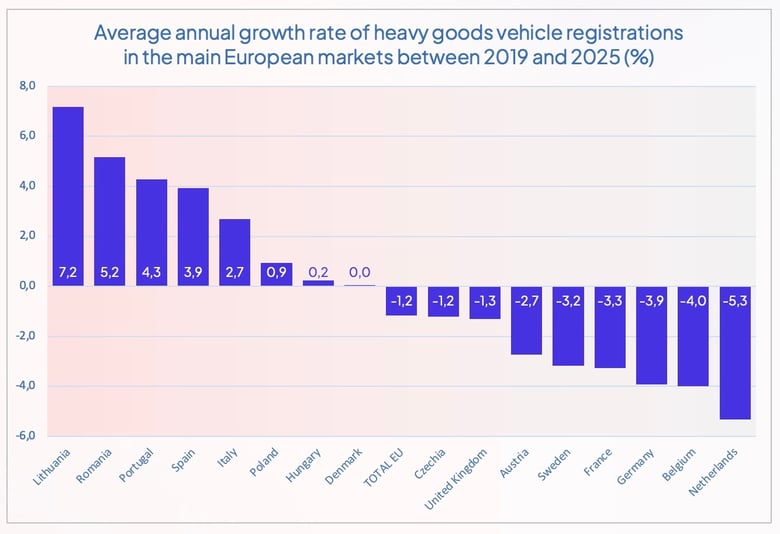
Figure 1 - Data source: ACEA - © Upply.
The Top 5, which also corresponds to the 5 largest economies in the EU, represents 69% of registrations in 2025. This market share has proven to be relatively stable over the years. However, the variations between countries are quite disparate.
→ Last year, the two main markets, France and Germany, recorded a 3rd consecutive year of decline in registrations, and the trend between 2019 and 2025 reveals a significant average annual contraction (see graph 1).
→ Spain and Italy, on the other hand, despite also experiencing a decline in 2025 compared to the previous year, show positive average annual growth. The Spanish fleet, in particular, made significant progress, benefiting from the healthy Spanish economy.
→ Poland returned to growth in 2025 and regained the 4th place in the EU standings for the number of new heavy goods vehicle registrations. The Polish fleet is today number 1 in Europe, but seems to be reaching a certain maturity, as evidenced by the moderate annual growth rate of the number of registrations over the period 2019-2025. This is also explained by the development of fierce competition from other Eastern European countries.
In 2025, Central and Eastern European countries (CEECs) accounted for 24% of new heavy goods vehicle registrations in the European Union. Poland is largely dominant, fuelled by its expansion in the international road transport market but also by a large domestic market. However, other Eastern European countries have decided to make road freight transport a strategic development axis of their economy. This is particularly the case for Romania and Lithuania, which respectively occupy the 7th and 8th rankings in the classification of European fleets. These two countries are developing an aggressive policy of conquering market share which is reflected in the registrations of new heavy goods vehicles, as evidenced by the average annual growth rate over the period 2019-2025.
The Czech Republic occupies an important place in the market, ranking 6th among European fleets, but the country is experiencing an erosion of the average annual growth rate. Like Poland, it is facing competition from its Eastern European counterparts.
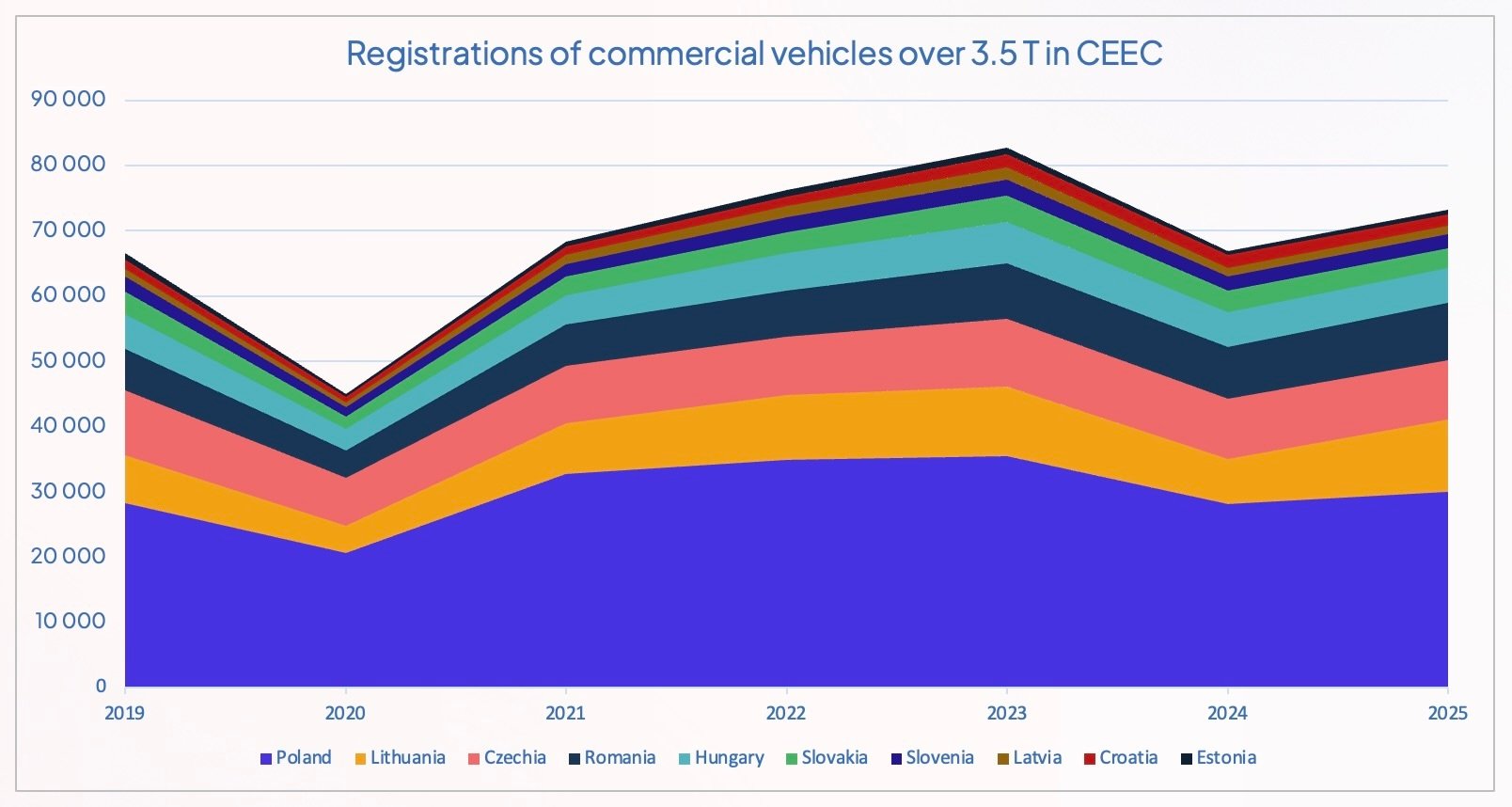
Figure 2 - *CEE excluding Bulgaria, for which figures are not available - Data source: ACEA - © Upply.
Electric vehicles still weigh more heavily in debates than they do in the statistics. In 2025, the share of diesel vehicles in total registrations of vehicles over 3.5t in Europe (EU+EFTA)[1]+UK) amounts to 92.7%, confirming the still largely dominant position of this engine type. The observation is similar if we just consider the European Union market. However, some signs indicate a stirring in the market.
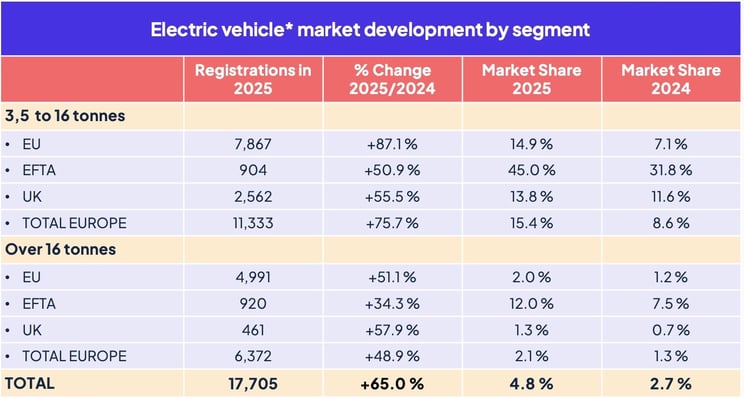
Table 2 - * Includes battery electric vehicles and plug-in hybrids - Data source: ACEA - © Upply.
→ Despite the undeniable dominance of diesel vehicles, the market share of electric vehicles is increasing, rising from 2.7% in 2024 to 4.8% in 2025.
→ The number of registrations of electric heavy goods vehicles increased by 65% in 2025.
→ The electric truck is gaining in attractiveness in the segment of vehicles from +3.5 T to 16 T, since its share in total registrations has doubled in the European Union compared to 2024 and almost doubled across the entire European market. The progression is particularly spectacular in EFTA, and especially in Switzerland, although the volume is modest.
→ The breakthrough of the electric vehicle is much slower in the heavy goods vehicle market of +16 tonnes. Admittedly, the market share is growing, but it is still limited to 2%. Here too, the EFTA countries stand out for the strength of the increase in registrations of electric heavy goods vehicles.
While the EFTA countries, as well as Northern European countries like Sweden and Denmark, stand out for their proactive approach, it is clear that in terms of volume, the major European road transport markets are vital.
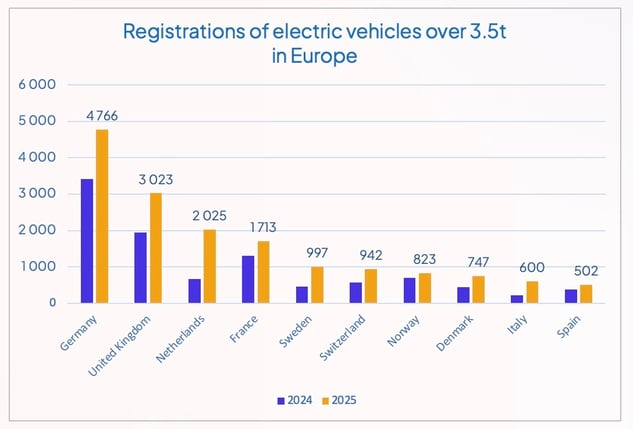
Figure 3 - Data source: ACEA - © Upply.
→ In terms of the number of electric vehicles newly registered, Germany still dominates with a total of 4,766 registrations in 2025, representing 6.2% of total new heavy goods vehicle registrations and an increase of 39.6% compared to the previous year.
→ It is ahead of the United Kingdom, followed by the Netherlands, which took the 3rd place on the podium occupied by France in 2024. France, with a share of 4.2% of electric vehicles in total heavy goods vehicle registrations, is slightly below the European average and has the lowest score in the Top 5.
→ The Top 10 has one major player that is conspicuous by its absence: Poland, the number 1 fleet in Europe, where only 178 electric vehicles were registered in 2025, representing 0.6% of total heavy goods vehicle registrations.
→ Other countries also show a notable reluctance with regard to the size of their fleet in Europe, Italy and Spain, where registrations of electric heavy goods vehicles represent only 2.2% and 1.7% of the total respectively.
Apart from the Northern countries, the electrification of the heavy goods vehicle fleet in Europe remains largely embryonic to this day. However, it seems to be gaining momentum in the segment of vehicles weighing between 3.5 and 16 tonnes. In the current state of technology, the electric heavy goods vehicle has begun to demonstrate its relevance on short and medium distances, which is not yet the case on long distances. This may also partly explain the weaker adoption of electric vehicles by major carriers such as Poland or Spain, which have a strong presence on international routes.
2/ Focus on the French market
According to data from the French Automobile Manufacturers Committee (CCFA), registrations of industrial vehicles over 5t on the French market reached 44,119 units in 2025, representing a drop of 9.9%. This decline comes after a very small increase of 0.3% the previous year. The heavy goods vehicle segment of +16 tonnes represents 38,445 registrations (-9.7%).
The rigid truck market, which had driven last year’s growth with a 15% increase in 2024, fell by 9.5% in 2025 with 21,249 registrations. As for the road tractor market, it continued its erosion, declining by 10.3% to 22,870 registrations.
The heavy goods vehicle market is expected to recover in 2026 after two years of decline. According to the Industrial Vehicle Observatory (OVI) of BNP Paribas Artegy, orders being taken for new tractor units are increasing sharply (+24.2%), and orders for rigid trucks are also increasing, albeit to a lesser extent (+5.3%). "The necessary renewal of fleets, delayed in particular by the wait-and-see approach linked to economic pessimism, has revived orders in 2025, which will produce the first registrations in 2026," estimates the OVI, which nevertheless remains cautious, with growth estimated between 0% and 5% at the most.
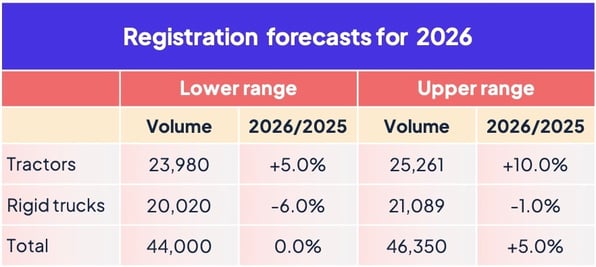
Source : OVI.
The Industrial Vehicle Observatory also anticipates significant growth in the fleet of electric trucks and light commercial vehicles, "thanks to a combination of accelerating factors, in particular a total cost of ownership (TCO) close to or comparable to diesel for certain uses," emphasises Arnaud Villéger, director of the Industrial Vehicle Observatory. The development and expansion of the range offered by heavy goods vehicle manufacturers, as well as the aging of the diesel fleet, are also factors likely to stimulate the electric heavy goods vehicle market.
[1] The European Free Trade Association (EFTA) is the intergovernmental organisation comprising Iceland, Liechtenstein, Norway and Switzerland, created to promote free trade and economic integration among its members, in Europe and around the world.