SPECIAL FEATURE 4/5. With more than 507 million tonnes handled in 2025, Dutch ports have reaffirmed their pivotal role in European trade. Dominated by Rotterdam, the national port system combines high performance and strong connectivity, while confronting growing pressures on capacity, energy transition and strategic positioning.
The Netherlands has established itself as an indispensable gateway for goods entering and leaving Europe. Total port throughput reached 507.2 million tonnes in 2025, a decline of 1.4% year-on-year, placing the country second behind Spain, whose ports recorded a combined volume of 556.5 million tonnes over the same period.
Rotterdam, located at the mouth of the River Meuse, accounts for the lion's share of activity, handling 428.4 million tonnes in 2025 — down 1.7% on the previous year — far ahead of Amsterdam with 62.1 million tonnes (-0.2%). The remaining 16.7 million tonnes are distributed across Ijmuiden, Beverwijk and Zaanstad, three ports situated along the Noordzeekanaalgebied, a canal linking Amsterdam's outer docks to the North Sea. Several port platforms have emerged in this area of Greater Amsterdam in recent years.
Rotterdam: Europe’s Container Shipping Cornerstone
In the container segment, the Netherlands handles approximately 14.7 million TEUs, compared with 18.6 million TEUs for Spanish ports combined. The country is home to Europe’s leading container port — Rotterdam — which recorded throughput of 14.2 million TEUs in 2025, up 3.1%. In tonnage terms, however, the picture is more nuanced: containerised cargo fell 0.2% to 133.2 million tonnes. Port management attributed the fluctuation to adverse weather conditions and industrial strikes at the start and end of the year. A rise in the number of empty containers — reflecting weak European demand and a decline in transshipment activity — also weighed on overall performance.
At the European level, Rotterdam maintains a clear lead over its closest rival, Antwerp-Bruges, where containerised traffic grew by just 0.7% in 2025. The two ports remain the only ones in Europe to exceed 10 million TEUs. Rotterdam also commands a significant global presence, ranking 12th in 2025 ranking of the world’s major ports — the highest-placed non-Asian port — and second if the combined throughput of Los Angeles and Long Beach is taken into account.
Growth in 2025 was driven by a 9.3% surge in imports from Asia. The year was also marked by a sharp rise in traffic to and from North America, a direct consequence of tariff policies introduced by the Trump administration. Importers moved to front-load orders ahead of potential duties, resulting in a 13.6% increase in traffic for the port of Rotterdam.
The reshaping of global carrier alliances from February onwards further boosted Rotterdam’s volumes, with a rise in East–West services calling at the port. The Gemini Alliance — grouping Maersk and Hapag-Lloyd — designated Rotterdam as its Northern European hub. However, the surge in traffic also triggered terminal congestion during the year. “A portion of that traffic was diverted to other North Sea ports,” port management acknowledged.
A Dense and Diversified Port Ecosystem
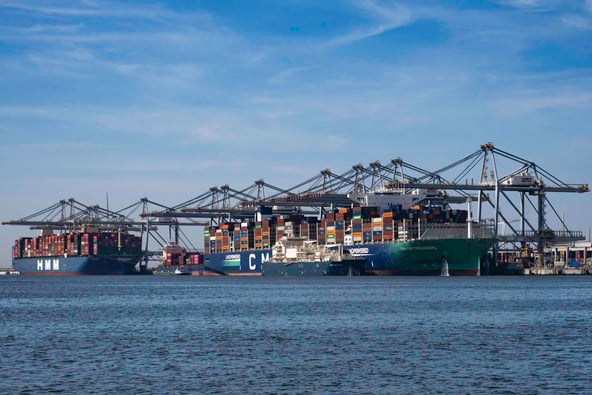
Europe’s leading container port, Rotterdam operates 14 terminals stretching over approximately 100 kilometres, concentrated primarily in its downstream reaches. The Maasvlakte 2, inaugurated in 2013, spans 2,000 hectares and is shared between two major container terminal operators: APM Terminals, which opened its first automated terminal in Europe there (though automation was subsequently scaled back after several months of operations), and RWG — a joint venture grouping DP World with several carriers including CMA CGM, ONE and Hyundai Merchant Marine.
Further upstream lies the Delta zone, home to several container terminals including Euromax, operated by European Container Terminals (ECT), a Dutch group acquired by Hutchison Ports in the early 2000s. The Hong Kong-based operator now manages multiple terminals at the port. In 2022, Hutchison signed an agreement with MSC’s terminal handling subsidiary, Terminal Investment Limited (TIL), to dedicate a terminal to the shipping line. Situated in the northern section of Maasvlakte 2, adjacent to the Delta Terminal, the future Europahaven terminal is scheduled for commissioning in 2027. It will offer five berths totalling 2,600 linear metres of quay and is planned as a fully automated facility.
Strong Rail and Inland Waterway Connectivity
Beyond its maritime container terminals, Rotterdam also hosts an extensive network of inland depots lining the Meuse. A combination of waterway and rail services connecting these various terminals helps prevent excessive congestion. The depots are managed partly by maritime terminal operators and partly by specialist logistics companies such as Hacon, Broekman and Kramer.
Rotterdam also benefits from outstanding European integration. Its position at the mouth of the Meuse provides a natural link to the Rhine, one of Europe’s most important waterways, offering direct inland access to Germany’s Ruhr region, Alsace-Lorraine, and — via the Main-Danube Canal connection — as far as Bavaria, Austria, Hungary and Romania.
On the rail side, Rotterdam benefits from connections to Germany, in particular Duisburg and the country’s industrial heartland, northern Switzerland, France and Italy. The port also takes full advantage of the Betuweroute, a dedicated freight rail corridor linking Rotterdam to the German network. Following years of upgrades, the line can now accommodate double-stack container trains and extends through to northern Italy.
New Logistical Challenges Ahead
Despite its leading position, Rotterdam faces significant logistical challenges if it is to maintain its competitive edge.
- Land capacity: Meeting growing demand for space is becoming increasingly difficult. As a country largely situated below sea level, the Netherlands faces substantial engineering requirements for any new terminal construction. At Maasvlakte 2, both APM Terminals and RWG are planning expansions that would add 46 hectares of land and 1,000 linear metres of quay. Combined with the Europahaven project, these developments could increase total port capacity by four million TEUs within the next two to three years.
- Energy transition: Rotterdam aims to become a European clean energy hub, targeting carbon neutrality by 2050 through large-scale development of green hydrogen, carbon capture and port electrification, as outlined in the climate transition plan published by the port authority in December 2025.
Integration into Europe’s Defence Strategy
Rotterdam has been identified as a strategically critical infrastructure node within the European Union’s new defence strategy. In December, the port announced the construction of a 15-hectare terminal dedicated to the Dutch Ministry of Defence, to be located in the north-western corner of Maasvlakte 2. The facility will serve as a transshipment and transit hub for military equipment, and forms part of a broader set of priority sites selected by the Dutch government to manage additional defence activities on national territory.
The Ministry of Defence requires guaranteed terminal capacity for handling vessels carrying military materiel, including equipment and munitions. According to an official port announcement, “it has been agreed within NATO that this type of cargo may be transported to and from the Netherlands, even when its final destination lies outside the Netherlands.” Onward distribution to final destinations will be handled by road, rail and inland waterway — necessitating the construction of a new rail link to the terminal. In addition to Rotterdam, the Ministry of Defence will continue to use the ports of Vlissingen and Eemshaven for military transport operations.
Amsterdam’s distinct role
Amsterdam operates on a different scale, handling 54,500 TEUs, and occupies a distinct market niche. Recognising the growth potential of containerisation, the port attempted to diversify into this sector in the 1990s to complement its traditional bulk cargo activities. In 1996, the Amsterdam port authority and U.S. group Ceres Inc. agreed to develop an innovative terminal, featuring a single dock capable of simultaneously handling one vessel on each side using nine gantry cranes. Opened in 2001, the terminal targeted an annual throughput of 900,000 TEUs and aimed to offer port calls of under 24 hours for the largest vessels of the era — 6,000 TEU ships.
Hampered by the relentless growth in vessel size and draught, the terminal, situated in the upper port, failed to generate the expected traffic volumes and closed in 2012. Today, Amsterdam’s container terminal is operated by Terminal Maritime Holding (TMA), an independent company that has formed a joint venture with Hutchison Ports for terminal management. The interest for the Chinese port handler is to have a terminal specialized short-sea shipping terminal just a few miles from Rotterdam, serving trade flows towards to the Baltic and Scandinavia. Grimaldi has also established a presence at the Dutch port, operating ro-ro and container-on-Mafi-trailer services. Both operators share a combined area of 80 hectares with 1,200 linear metres of quay.