After a very dynamic start to the year, global air cargo took a sharp downturn in March 2026. Disorganisation of Gulf hubs, soaring kerosene prices and calendar effects related to the Chinese New Year have caused a contraction in volumes, while fuelling strong pressure on prices.
1/ The evolution of supply and demand
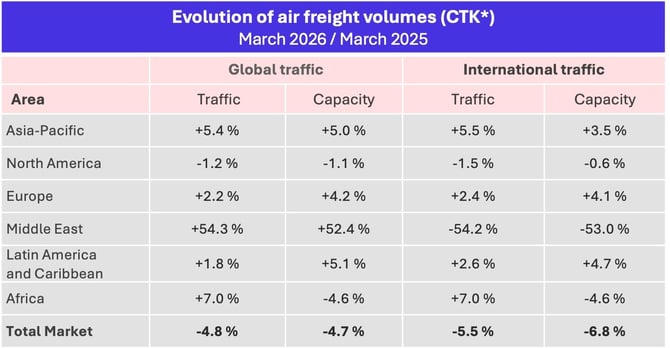
According to IATA, global demand for air cargo, expressed in cargo tonne-kilometres, declined by 4.8% in March 2026 compared to March 2025. On international routes alone, the decline reached 5.5%.
The decline is very geographically concentrated. Middle Eastern airlines have seen a dramatic 54.3% drop in overall traffic, and 54.2% in international traffic. Conversely, all other regions recorded an increase in traffic, with the exception of North America, which saw a slight decline of 1.2%.
Capacity has decreased in proportions quite similar to those of traffic with a decrease of 4.7% globally and 6.8% internationally, which allowed the load factor to remain almost stable at 47.9%. Volumes carried by all-cargo aircraft fell by only 0.9%, compared to a 12.1% drop for cargo carried on mixed aircraft, as passenger networks were more disrupted by airspace restrictions and frequency reorganisations.
* CTK: cargo tonne-kilometres - Data source: IATA.
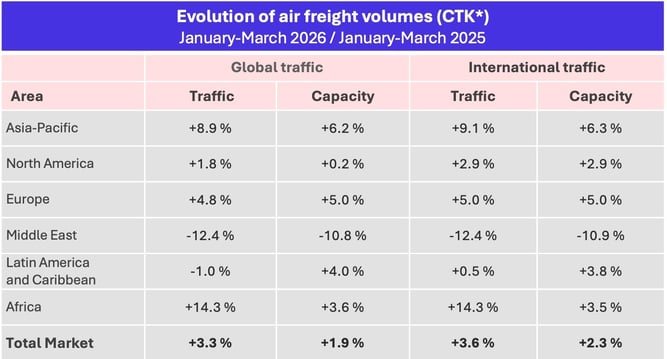
This break comes after a promising first two months. Overall, the market remained positive for the first quarter, with a growth of 3.3% in global volumes and 3.6% on the international market. But March marked a clear change in trend.
* CTK: cargo tonne-kilometres - Data source: IATA.
A strong divergence between corridors
The broad-based analysis conducted by IATA confirms the extent of the disorganisation of flows related to the situation in the Persian Gulf.
- The Europe-Asia corridor remains the most dynamic, with growth of 14.2% year-on-year, continuing a long series of 37 months of uninterrupted growth. In March, this route benefited in part from a reorganisation of networks, with companies developing direct flights due to operational difficulties affecting Middle Eastern hubs.
- The intra-Asia flows also progressed by 7.5% supported by regional manufacturing exchanges.
- Conversely, corridors directly exposed to the Middle East are plummeting: Middle East-Asia fell by 58.6% and Europe-Middle East by 57.6%.
- The Europe-North America corridor also slipped slightly into the red, at -3.4% year-on-year. However, IATA points out that this trend is mainly due to a normalisation effect. Even though the thunderous announcement of the new tariffs from the United States only came on April 2nd, importers had started building up stocks as early as March because the threat was already looming.
- Trade between Asia and North America remained positive, but also lost momentum, registering an increase of only 0.8%. Here too, this slowdown in transpacific flows seems to indicate mainly a return to normal after the temporary anticipation of demand observed at this time last year.
2/ Price trends
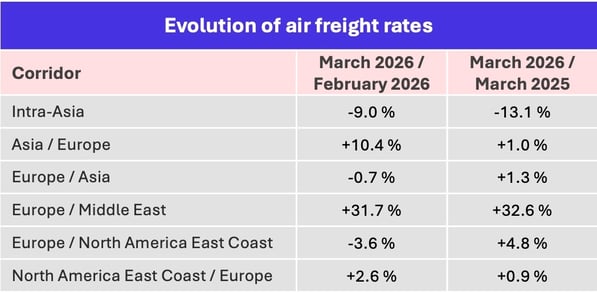
The decrease in volumes did not lead to a reduction in prices. On the contrary, prices continued to climb, driven by soaring kerosene prices. IATA reports that jet fuel prices jumped 106.6% year-on-year in March, reaching their highest level in over 23 years!
According to IATA, the average unit revenue increased by 13.6%, both month-on-month and year-on-year, reaching $2.75/kg. Upply data confirms this trend, with a very direct impact on the Europe/Middle East corridor, but also on the Asia-Europe corridor which is experiencing a contraction in capacity.
Source : Upply.
According to preliminary data from WorldACD, April was marked by a clear rebound in volumes, after the slump observed in March. Prices continued to soar, the average global air cargo price stood at $3.17/kg in April, its highest level since the beginning of the year.
3/ Outlook
Macroeconomic indicators remain mixed. IATA emphasises that global manufacturing activity remains in expansion territory, with the Purchasing Managers' Index (PMI) at 51.4 and an index of new export orders to 50.1. These conditions are favourable to demand for air cargo. Air cargo, due to its responsiveness, can even to some extent come out on top, offering the necessary flexibility to supply chains needed to adjust to changing geopolitical conditions.
However, clouds also hang over the activity. Major global institutions have revised their economic growth forecasts for the whole year downwards. On the other hand, the conflict in the Middle East is having a significant impact on fuel supplies. Beyond even the soaring prices, the shortage of kerosene now constitutes a serious threat.
The determining factor in the coming months will therefore be the duration of the conflict in the Middle East, because the longer it lasts, the longer it will take to return to normal. Air cargo is therefore entering the second quarter in a mixed situation: demand seems capable of rebounding quickly, but operational difficulties persist and costs and prices are increasing.