SPECIAL FEATURE 1/5. The Netherlands ranks fifth among the economies of the European Union, playing a major role in international trade in particular.
Gateway to Europe and historically recognized for its maritime dominance and leadership in international trade, the Netherlands continues to stand out in its core business: connecting markets. Over centuries, the Dutch have transformed their geographical position into a strategic advantage, combining commercial tradition with technological innovation to serve a broad range of industries.
This article examines the evolution of the Dutch economy, its role in international trade, the challenges related to labour markets and technological innovation, as well as the growing importance of energy transition and sustainability in shaping the country’s long-term strategic trajectory.
A strategic geographic position
With a GDP of approximately €1.2 trillion, the Netherlands ranks as the fifth largest economy in the European Union and maintains one of the highest GDP per capita levels in the region (Eurostat). Unlike countries such as Germany or France, where domestic consumption plays a larger role in economic activity, the Dutch economy is deeply oriented toward international trade.
The country’s strategic geographic position reinforces this role. Goods originating primarily from Asia and the United States enter Europe through Dutch ports and airports and are rapidly redistributed across the continent through a highly integrated logistics network combining inland waterways, rail corridors and road transportation.
A diversified industrial base
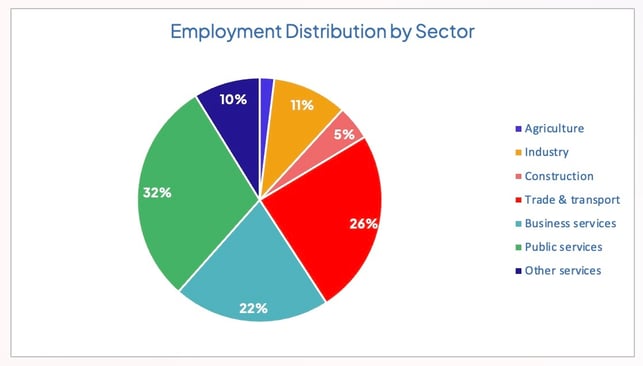
The country hosts a diversified industrial base that ranges from highly productive agriculture and advanced logistics to machinery manufacturing, construction, chemical industries and the production of critical equipment for the global semiconductor and artificial intelligence industries. This economic diversity contributes significantly to the country’s resilience even during periods of global crisis and uncertainty.
Source: CBS
An economy shaped by international trade
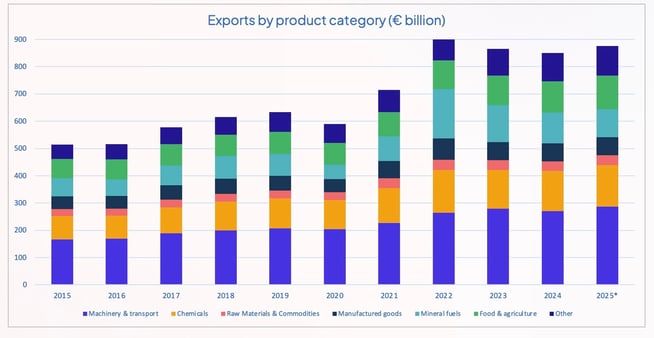
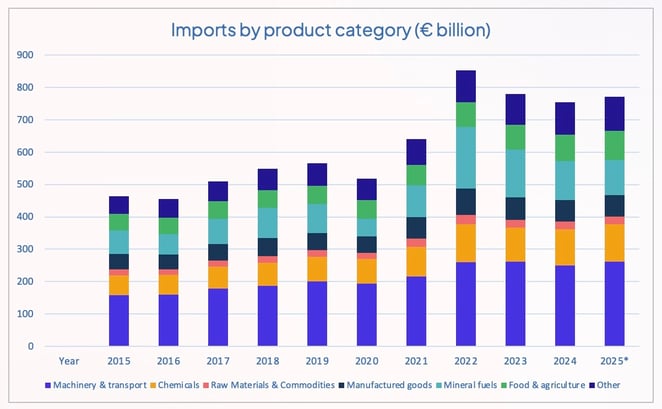
Representing roughly 74% of GDP, the Dutch exports continues to expand steadily. Trade figures illustrate this dynamic. Exports are expected to reach approximately €876 billion in 2025, representing a 70% increase compared with 2015, while imports reached approximately €771 billion.
Manufacturing output has grown at a more moderate pace, projected to expand roughly 60% over the past decade (Eurostat). This trend suggests that the country’s competitive advantage lies less in large-scale manufacturing expansion and more in its integration within international logistics corridors and value-added trade services.
Source: CBS
Source: CBS
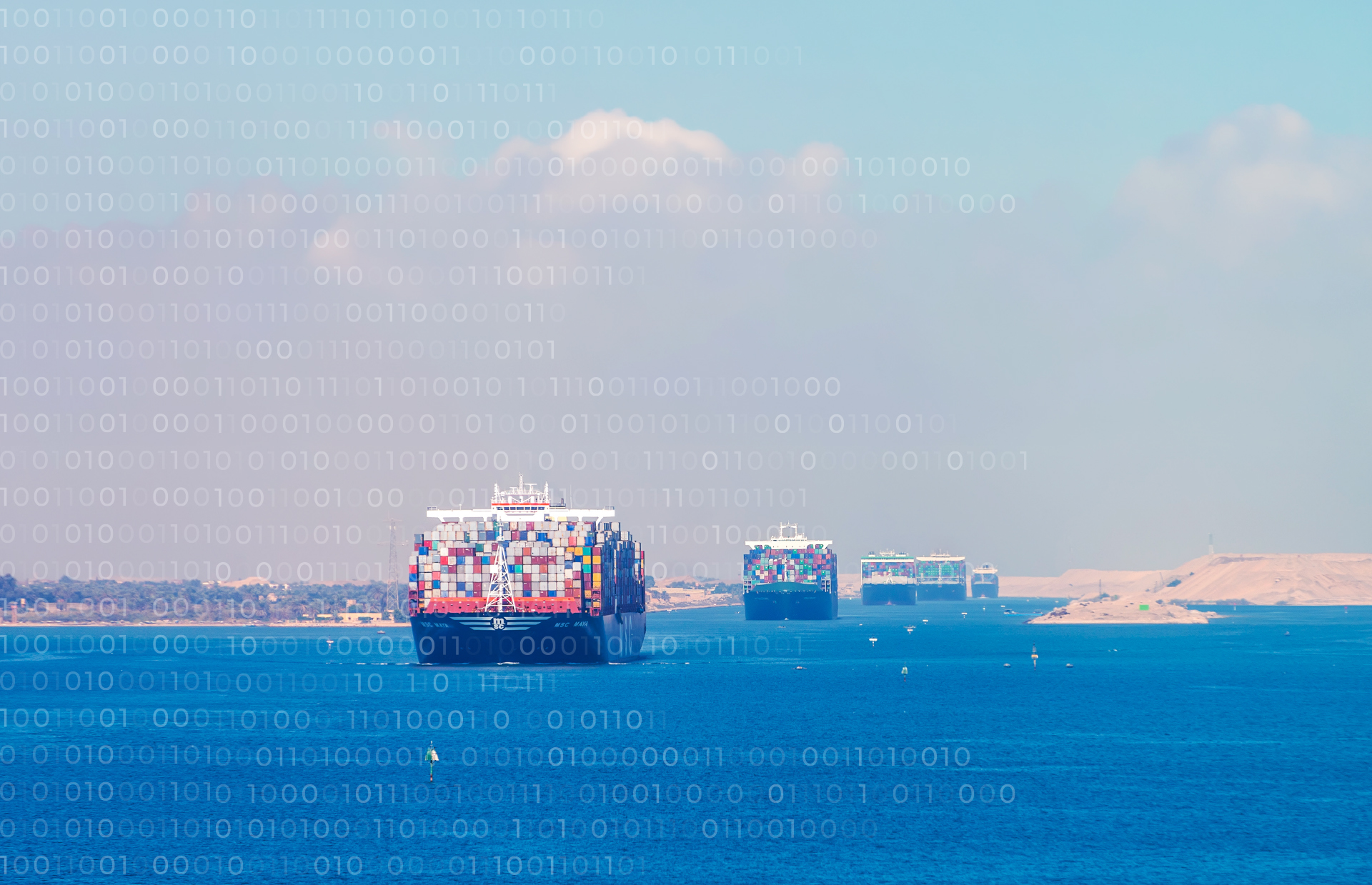
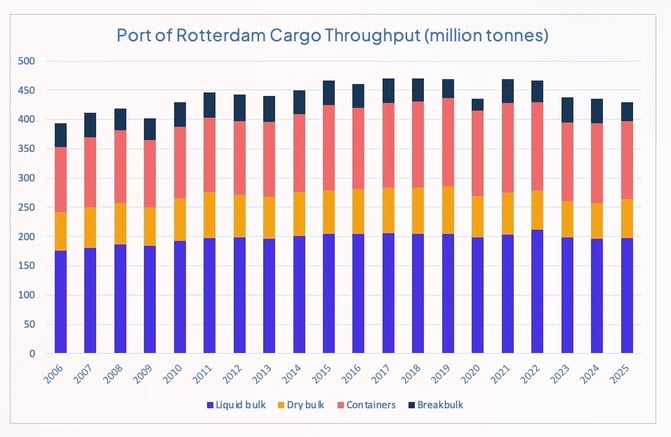
A significant share of global trading operations is supported by a sophisticated financial system and port infrastructure operating at a large scale. The port of Rotterdam, the largest port in Europe, handles approximately 440 to 450 million tonnes of cargo annually, dominating liquid bulk and container flows within the European market.
Data source: Port of Rotterdam Authority.
New trade patterns
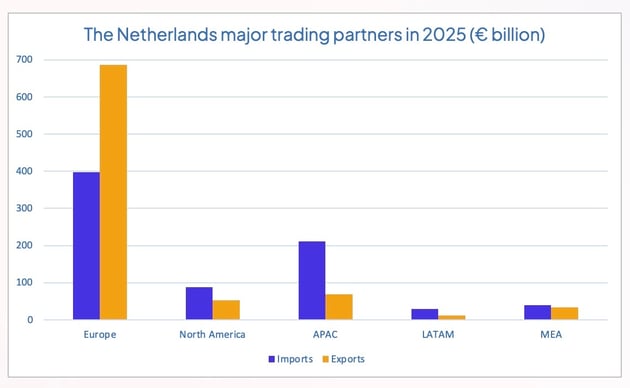
Trade patterns have also evolved geographically. While intra-European trade has grown by approximately 79% on exports and 54% on imports over the last decade, imports from Asia and MEA (Midde-East and Africa) have expanded more rapidly, increasing 72% since 2015 and accounting for roughly 27% of total imports. Exports to North America have increased by approximately 121% during the same period, reflecting stronger transatlantic supply chains and growing demand for Dutch high-technology equipment, chemicals and industrial inputs.
Source: CBS
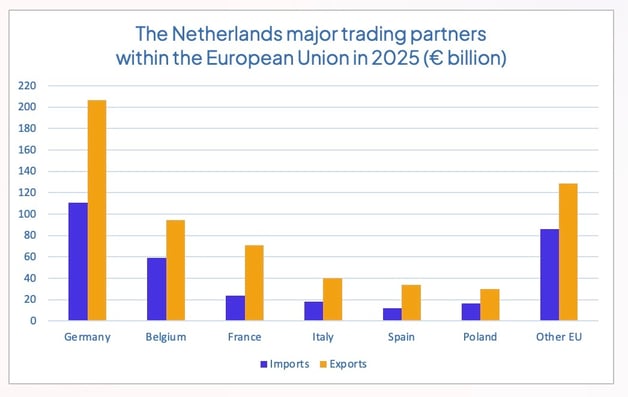
Within the European Union, trade relations with traditional partners such as Germany, Belgium and France remain dominant. However, supply chain reconfiguration has increased the importance of Central and Eastern Europe, particularly Poland, where Dutch exports have grown by more than 150% and imports by over 105% during the last decade.
Source: CBS
Innovation and technology
Historically, the Netherlands has demonstrated a strong ability to adapt to geographic and economic challenges through technological innovation. From large-scale land reclamation to advanced water management systems, engineering and technology have long been central to the country’s development. Economic indicators show that wealth creation has consistently outpaced population growth.
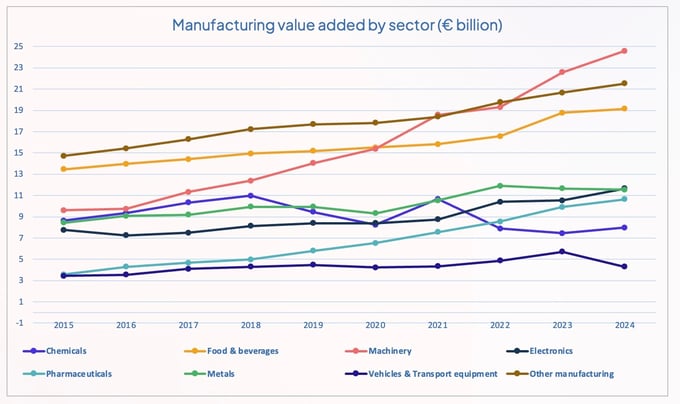
Public policies have supported a diversified industrial structure, with key sectors including machinery and electronics (32,5% of the manufacturing value added in 2024), food and beverages (17,6%) and chemicals and pharmaceuticals (16,7%). This industrial composition contributes to strong export productivity. On a per capita basis, Dutch exports are nearly three times higher than the European Union average (Eurostat).
Source: CBS
Innovation remains a key driver of this transformation. The city of Eindhoven has become one of Europe’s leading high-technology hubs, largely due to its semiconductor equipment industry. Companies such as ASML produce advanced lithography systems used globally in semiconductor manufacturing, placing the Netherlands at the centre of a critical segment of the global technology supply chain.
Structural labour shortages in several sectors
The labour market also shows robust performance. More than 50% of the population is employed, while total employment in 2025 is approximately 16% higher than in 2015. During the same period, unemployment declined from 7.6% to approximately 4.0% in the end of 2025, according to CBS.
Agricultural employment in 2025 is approximately 11% lower than in 2015, and industry kept same number of jobs, reflecting technological improvements and mechanization. while employment in trade, transportation and business services increased by roughly 18% over the same period. However, high employment levels combined with relatively high labour costs create structural labour shortages across several sectors, including transport and logistics.
Energy transition and sustainability
The Netherlands’ strong integration into global trade also implies high levels of energy consumption. Therefore, energy efficiency has become increasingly central to national economic strategy. Historically, Dutch windmills already symbolized the country’s ability to harness natural energy resources. Over the past five decades, however, the country’s energy system has undergone a significant transformation.
The Netherlands progressively replaced coal with natural gas following the discovery of the Groningen gas field, and more recently accelerated the transition toward renewable energy sources, particularly offshore wind and solar generation. Currently, approximately 33 % of households are equipped with rooftop solar panels, while around 3,500 wind turbines contribute to a renewable capacity close to 58 GW, supplying roughly half of the country’s electricity generation, according to CBS.
Transportation remains one of the sectors most dependent on fossil fuels. Although renewable alternatives are increasingly being adopted in road and inland waterway transport, the electrification of heavy-duty freight vehicles still depends on the expansion of European charging and hydrogen infrastructure. In passenger mobility, however, the transition is advancing rapidly. Electrified vehicles represent roughly 14% of the Dutch passenger car fleet, while around 49% of new vehicle registrations correspond to electric or hybrid vehicles (RVO; European Alternative Fuels Observatory).
This diversification of energy sources strengthens the resilience of the Dutch economy and reduces exposure to energy supply disruptions. Still, despite technological advances, one traditional symbol of Dutch sustainability remains unchanged. Rain or shine, the bicycle continues to be one of the most widely used modes of transportation, demonstrating that sustainability can also be efficient and cost-effective!
References
-
CBS Netherlands (Statistics Netherlands).
-
National Accounts and International Trade Database, Eurostat.
-
Port of Rotterdam Authority - Annual Throughput Reports.
-
World Bank - Netherlands Economic Indicators.
-
International Energy Agency, Netherlands Energy Profile.
-
RVO Netherlands - Electric Mobility Statistics.
-
European Alternative Fuels Observatory.