Global demand for air cargo increased by 7.7% year-on-year in September 2026, a sharp acceleration compared to August. But the price of kerosene has more than doubled in a year, and cargo rates are struggling to keep up.
1/ Supply and demand
* CTK: cargo tonne-kilometres - Data source: IATA.
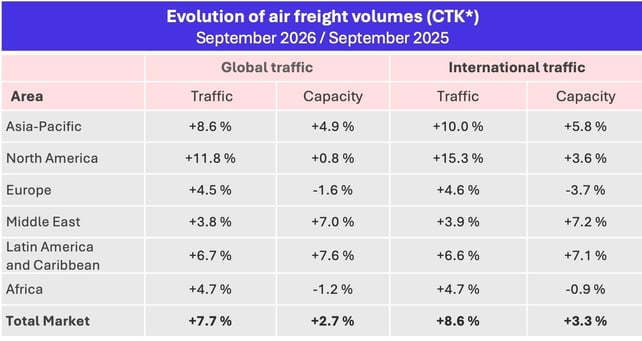
Global demand for air cargo, expressed in tonne-kilometres, increased by 7.7% year-on-year in September 2026, and by 8.6% on international routes alone. Growth accelerated sharply compared to August (+4.4%) and airlines in all geographical areas benefited from this. Asia-Pacific and North American companies alone account for 77% of the increase in global traffic according to IATA, with 721 and 678 million additional tonne-kilometres respectively. North American companies show the strongest growth, both overall (+11.8%) and on international routes (+15.3%). Data from WorldACD confirms this rebound: global tonnages increased by 3% month-on-month and 9% year-on-year in September, with an increase in all major regions of origin.
Capacity, measured in available freight tonne-kilometres, increased by 2.7% compared to September 2025, and by 3.3% for international operations. This growth comes mainly from companies in Asia-Pacific (+4.9%) and the Middle East (+7.0%), which account for 59.6% and 34.9% of net supply growth respectively. Conversely, European (-1.6%) and African (-1.2%) companies reduced their capacities.
With demand growing much faster than supply, the load factor gained 2.2 points overall to reach 47.9%, and 2.6 points on international routes (52.9%). North American companies recorded the strongest improvement (+4.3 points, to 43.9%), with traffic up 11.8% for a virtually stable supply (+0.8%).
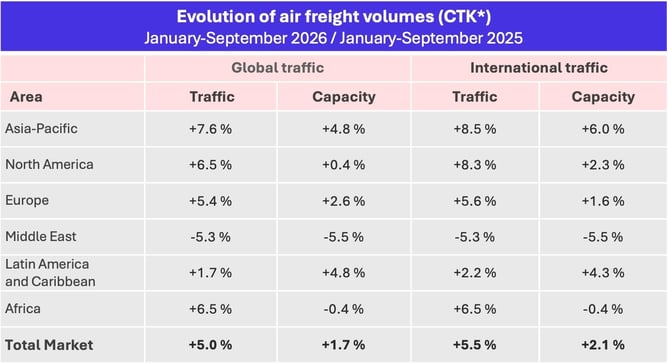
Year-to-date at the end of August, global air cargo traffic showed growth of 4.6%, with supply increasing by 1.5%. Only companies in the Middle East, affected by the war in the Persian Gulf, remain in decline (-5.3%). Their traffic did increase by 3.8% in September, but less quickly than their capacity (+7.0%), which caused their load factor to fall by 1.4 points.
* CTK: cargo tonne-kilometres - Data source: IATA.
2/ Development by corridor
- Asia-North America: the world’s largest corridor is once again the main source of growth, with an increase of 17.0% in September, compared to 13.2% in August. It thus shows 8 consecutive months of progress, including 5 months of double-digit growth. This corridor is literally boosted by shipments of semiconductors, servers and equipment for artificial intelligence infrastructure, which support volumes destined for the United States. According to WorldACD, China's tonnage to the United States increased by 17% year-on-year in September, and South Korea's and Japan's by 54% and 47% respectively in mid-September.
- Asia-Europe: The second busiest route in the world, the Asia-Europe corridor, saw a 6.0% increase in traffic measured in tonne-km in September, accelerating compared to August (+3.1%), representing a 43rd consecutive month of increase. However, growth remains below the rate observed in the first half of the year. IATA sees this as the effect of the removal, on the 1st of July 2026, of the exemption from customs duties on small parcels imported into the European Union, which weighed on e-commerce. According to WorldACD, tonnages from China and Hong Kong to Europe fell by another 10% year-on-year in September, although the decline was less pronounced than in July (-14%) and August (-15%). The contrast remains stark between Hong Kong, heavily reliant on e-commerce (-24%), and mainland China (-2%), where volumes have almost returned to their June level.
- Intra-Asia: traffic increased by 10.2% in September, a marked acceleration compared to August (approximately +6%). This corridor thus records a 35th consecutive month of increase, it is also still supported by flows related to the development of artificial intelligence.
- Transatlantic: on this route, traffic increased by 9.3% year-on-year in September, more than twice as fast as in August (+4.3%), and recorded its fifth consecutive month of increase.
- Middle East: the region remains penalised by the conflict in the Persian Gulf, which weakened its role as a hub for interchange. Traffic declined for the seventh consecutive month on the Europe/Middle East axis (-18.0%, compared to -15.1% in August) as well as on the Middle East/Asia axis (-10.2%, compared to -14.6%). According to WorldACD, capacity to and from the Gulf region remained at the end of September approximately 17% below its pre-conflict level.
3/ Price trends
In September, the price of Brent reached $116.8/barrel, due to persistent disruptions to supplies in the Persian Gulf and tensions on shipping routes and energy infrastructure. Refining amplified the shock: the decline in Russian exports reduced the supply of middle distillates, and refiners favoured the more profitable production of diesel. The global price of kerosene thus reached $184.5/barrel, up 17.5% over a month and 103.4% year-on-year.
Companies are trying to pass on this increase in their operating costs through fuel surcharges, which is impacting cargo rates. According to IATA, average air cargo yields (including surcharges) increased by 2.0% month-on-month, its second consecutive increase, and by 25.9% year-on-year.
For shippers, the price increase compared to last year is very significant as the high season approaches. According to data from WorldACD in September, global average rates, spot and contracts combined, rose by 1% month-on-month and were 25% higher than those of September 2025, a gap comparable to that of July and August (+24%). The increase is strongest from the Middle East and South Asia (+52%), followed by Africa (+27%), Europe (+24%), Asia-Pacific (+23%) and North America (+18%). On the China-Europe route, the average rate has risen to $4.53/kg, compared to $4.26/kg in August, but remains far from the $5.22/kg of June. On the China-United States route, spot rates averaged $6.05/kg, up 30% year-on-year. Over the whole of the third quarter, average rates fell by 7% compared to the second quarter, marked by the peak of the crisis in the Middle East, but they remain 24% higher than their level in the third quarter of 2025.
On the corridors followed by Upply, the developments in September are more contrasting. Rates have risen sharply on the Asia/Europe route (+5.9% over one month, +8.3% over one year), a trend consistent with the rise in China-Europe rates noted by WorldACD. They also increased on the North America (East Coast)/Europe route (+1.9%) and remained stable within Asia (+0.3%). However, they declined when departing from Europe, towards the Middle East (-6.8%), towards Asia (-5.6%) and towards the East Coast of North America (-4.8%).
October data indicates a strengthening of prices at the start of the high season. According to WorldACD, global average rates have risen by 5% month-on-month and 29% year-on-year, with monthly increases of 6% from Asia-Pacific and Europe. Spot rates gained 6% over a month, to an average of $3.67/kg (+37% year-on-year), and accelerated further at the end of October, to $3.93/kg in week 44 (+40% year-on-year). On the China-Europe corridor, the average rate increased by 9% over a month, to $4.85/kg (+14% year-on-year), despite tonnages still in sharp decline (-17% year-on-year from China and Hong Kong). On the China-United States corridor, it increased by 7%, to $6.47/kg (+30% year-on-year), almost returning to its May-June levels. Global tonnages, meanwhile, increased by 5% over a month and by 6% over a year.
4/ Trends
Demand remains on a positive trajectory. In September, the global manufacturing PMI (production) gained 0.7 points to 53.8, and the index of new export orders gained 0.5 points to 51.9: both indicators reached their highest level in more than five years. IATA also points out that figures from the World Bank's Global Economic Monitor reveal a 0.5% increase in industrial production in August on a month-on-month basis, after stagnation in July. "Production was 3.6% higher than the previous year, representing its strongest annual increase in almost a year and the 42nd consecutive month of growth," IATA specifies. Finally, global merchandise trade volumes increased for the fifth consecutive month in August (+0.6% month-on-month) and show a 6.9% year-on-year increase, according to the CPB World Trade Monitor.
Transpacific flows are expected to remain very dynamic during the peak holiday season. On the Asia-Europe corridor, the outlook is more uncertain. Since the 1st of November, a processing fee of €2 per item was added to the flat-rate customs duty of €3 on e-commerce parcels imported from third countries. The major Chinese platforms, which had built their cross-border e-commerce logistics model on air shipments, are reviewing their plans in order to reduce the impact of this new regulation. They have also anticipated the movement, by setting up warehouses in Europe supplied, admittedly still partly by air, but also by sea. Shein is one of the most emblematic examples: in 2022, the platform opened a logistics hub in Wrocław, Poland, with a surface area of 740,000 m². The Chinese operator has just announced a new investment of 500 million euros which will bring the surface area to more than one million square meters.