BAROMETER. According to shipping intelligence firm Alphaliner, 63% of Asia-Europe traffic is now transiting through the Suez Canal. Shippers, who did not ask for this, could nevertheless benefit if this trend results in a fall in freight rates.
The situation in the Middle East
The situation in the Middle East remains tense. According to a report in French daily Le Monde, a drone, which threatened a CMA CGM container ship, was brought down by a French frigate in the Bab el-Mandeb Strait, while, at the same time, the Houthis are increasingly attacking Saudi Arabian targets.
The shipping companies are nevertheless increasingly returning to the Suez Canal. According to Alphaliner, 63% of Asia-Europe traffic is now transiting through the Suez Canal. Shippers neither sought nor anticipated this logistical return to the Red Sea but have no choice but to pay the additional cargo insurance required to cover the extra risk involved.
It is too early, however, to talk about a return to normal. The current situation is already having significant consequences on ports. Top-ranking ports like Jebel Ali, Doha and Abu Dhabi, find themselves operating almost like dry ports, handling merchandise essentially via overland routes. This is an enormous change for the container shipping industry. Dubai Ports has switched rapidly to local investment, away from the strait. In the meantime, the shipping companies are building large-scale, alternative logistical systems, not only as an emergency solution in the face of crisis but also for the long-term. Instability has become a constant factor.
It is in this highly volatile and uncertain environment that the annual contract negotiating round is getting under way in Europe. The shipping companies point out that, in relation to last year at the same point, their operating costs have soared by about USD 400 per 40’ unit, mainly because of an increase in bunker prices and tensions regarding fuel supply in Asian ports.
Prices
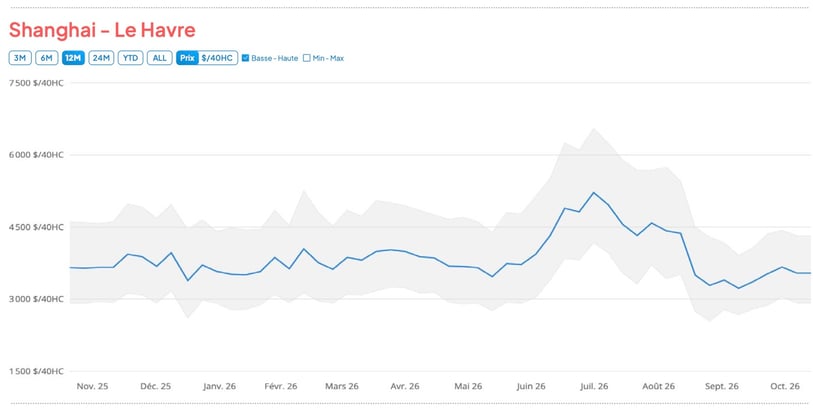 Port-to-port rates (spot and contract combined) billed for direct sailings from Shanghai to Le Havre, departure and destination port THCs included, for a 40' HC DRY container carrying dry, non-dangerous goods. NB: diagram shows median not average rates. Source: Upply.
Demand remained on a positive trend in October, although the growing return to the Suez Canal can be expected to lead to congestion in Europe in November and December. The spot market is very active with some fairly aggressive freight rates on offer. The psychologically important USD 3,000 barrier per 40’ container can be expected to be broken shortly (...)
This content is for Upply subscribers only.
If you are already logged in but still cannot access all the content, please contact us!