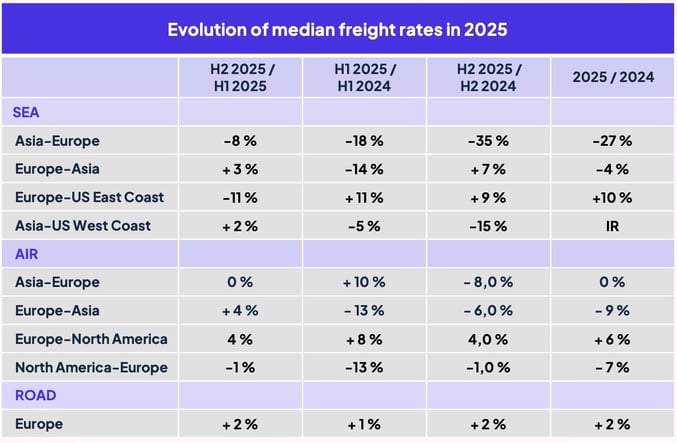
In 2025, global trade in goods grew by 4.6% in volume, according to the WTO, compared with 2.7% in 2024. Freight rates were disrupted by geopolitical factors in the air and maritime sectors, while European road transport prices rose by 2% year-over-year.
Europe was the only continent where exports declined in volume in 2025 (-0.5%).
Maritime freight rates fell on the Asia-Europe and Trans-Pacific routes in 2025, despite an increase on the Transatlantic route.
The WTO does not rule out global trade growth being limited to 1.4% in 2026.
In 2025, freight rates in the air and sea transport sectors were affected by the geopolitical environment but remained relatively stable in the European road haulage industry. Evaluating demand and making the necessary capacity adjustments is becoming increasingly complex.
1/ Stable growth
In 2025, global GDP grew by 2.9%, according to World Bank figures, and by 1.8% in the advanced economies alone.
Among the advanced economies, we saw a slowdown in the United States, where growth fell from 2.8% in 2024 to 2.1% in 2025. The euro zone, on the other hand, registered an increase from 1% to 1.4%, while Japan recorded an increase of 1.1% after going into recession in 2024 (-0.2%).
Emerging economies and developing markets saw their GDP increase by 4.4%, driven by China, which showed 5% growth and India, which saw growth rise from 7.1% in 2024 to 7.7% in 2025.
2/ Trade dynamism
According to the World Trade Organisation, world trade in goods by volume grew 4.6% in 2025. This figure was markedly up on the 2.7% increase in 2024. The 2025 increase was fed by demand for products linked to the development of artificial intelligence. At the same time, prices for goods increased by about 2%, which led to a 7% global increase in trade in goods by value.
Asia remained the export driver with a volume growth rate of 9.5% from an already high reference base, while its imports grew by 6.1%.
North America saw volume export growth of 3.1%, with imports growing by the same amount.
Europe was the only continent to suffer a volume export decline (-0,5%), while imports grew 2.1%.
The year 2025 was not a simple one for world trade operators. The new Trump administration launched a highly aggressive new trade policy, which took the form of huge increases in customs duties. World trade did not collapse, however. In the first place, the United States had to take considerably more time over the introduction of these measures than originally planned, particularly in the face of a vigorous Chinese riposte. Also, the announcement of the new tariffs led to peaks of activity, notably in the first half, as orders were placed early. And, finally, dynamic growth in certain sectors, particularly products linked to the development of artificial intelligence, stimulated growth.
3/ Contrasting freight rate performances
The trade war had diverse effects on international transport prices.
In air freight, it limited the fall in prices which had been expected as a result of the increase in capacity resulting from the development of passenger transport networks and the increase in hold this involved. Peaks in last-minute demand resulting from the stop-go execution of US customs policy was also favourable for the air cargo sector. Shippers turned to the reactive air transport sector to build up emergency stocks before the introduction of increases in customs duties, as was seen particularly in the transatlantic trades. The sector also benefited from growth in certain growth market segments like e-commerce and high-tech products.
The shipping companies also held their own in the transatlantic market, but this was not enough to compensate for the fall in rates in the Asia-Europe and transpacific markets. This latter decline was the result of a classic imbalance between supply and demand. The shipping companies are currently taking delivery of the many ships they ordered during the post-Covid period, and demand was simply insufficient to absorb the new capacity. In 2024, Houthi attacks on ships in the Red Sea disorganised logistics chains by forcing ships to divert round the Cape of Good Hope. This instability enabled the shipping companies to increase their rates. This was not the case, however, in 2025, when the new longer routes had been assimilated into supply chain planning
The performance of the European road haulage sector reflected the still modest growth in the euro zone, despite an improvement over 2024. The failure of Germany to resume playing its locomotive role affected economic activity overall. Road haulage rates increased 2% year on year over the year as a whole and by 3% on the spot market.
Source: Upply ; spot and contract rates as billed.
4/ Outlook
Before the start of the current conflict in the Middle East, the World Trade Organisation was already expecting a slowdown in trade in goods in 2026 – 1.9% followed by a recovery to 2.6% in 2027. On the basis of the updated forecast it published in March, however, it does not exclude a lower growth rate of 1.4% this year, followed by a higher 2.8% rate in 2027. In the forecast it made in June, the World Bank estimates that growth in trade in goods and services could fall from 4.8% in 2025 to 2.9% in 2026. It explains this slowdown by the end of early ordering, the deferred impact of changes in customs duties and the effects of the conflict in the Middle East, particularly the disruption caused by the closure of the Strait of Hormuz. The only glimmer of hope, according to both the WTO and the World Bank, comes from demand for products linked to artificial intelligence, which promises to remain steady despite the difficult environment.
The situation is already impacting transport prices. Ocean freight rates began rising again in spring 2026.The same is true in the air freight business, where the International Air Transport Association (IATA) increased its 2025 air freight revenue growth forecast even though it maintained its low growth forecast for cargo volumes. In the road haulage sector, the surge in fuel prices is also pushing up freight rates even though, here too, the outlook for cargo volumes is unfavourable. By reviving inflation, the conflict in the Middle East could have an impact on household consumption and company investment at a time when European economies are caught in the crossfire of the relentless trade war between China and the United States.
CONTENTS
The main trends for the transport and logistics market in 2026
Graduated from the Superior School of Journalism in Lille, Anne spent most of her career in the international trade and logistics press, before joining Upply.