The outbreak of the conflict in the Middle East has disrupted growth scenarios for 2026. After the Covid pandemic in 2020, the war in Ukraine in 2022 and the tariff war in 2025, supply chains are suffering a new shock which confirms the need for a change of model.
2026 had started on a rather positive note, thanks to activity that was supported by investments in artificial intelligence and a lull in trade tensions. But hopes for an acceleration of global growth were dashed by the outbreak of the conflict in Iran on February 28, 2026.
A growth forecast revised downwards
- The weakest growth since the Covid-19 pandemic
"The conflict in the Middle East is expected to slow global growth to the lowest rate since the onset of the COVID-19 pandemic amid higher energy prices, steeper inflation, and increased borrowing costs”, according to the World Bank. According to its updated forecasts in June 2026, global growth is expected to slow to 2.5% in 2026, compared to 2.9% in 2025. For two-thirds of the world's economies, forecasts have been revised downwards compared to those established in January of this year.
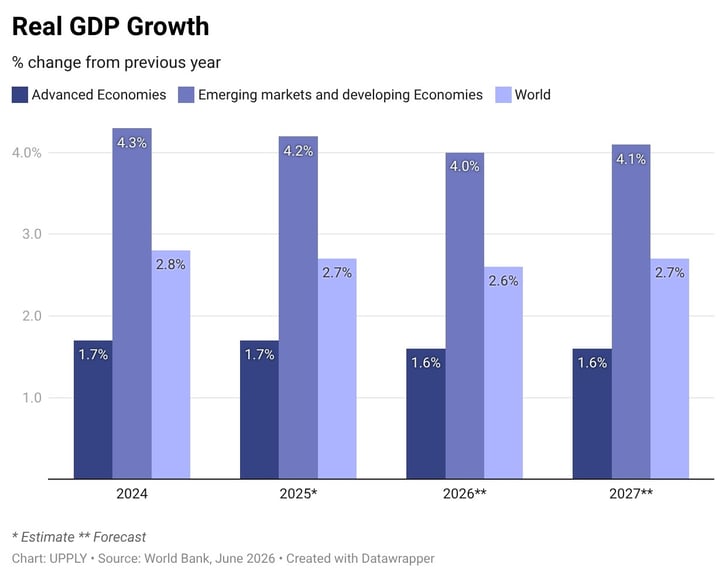
Being a little more generous, as is their wont, the OECD and the International Monetary Fund (IMF) respectively mention a growth of 2.8% and 3.0% of global GDP, but agree on a downward revision of the outlook. And the prolongation of the conflict in the Persian Gulf does not bode well. "The longer these disruptions last, the higher the economic and social costs become. Should the disruptions persist well into 2027, global growth is expected to slow significantly, to just 2.1% in 2026 and 1.8% in 2027, potentially pushing some economies into or close to recession”, warns the OECD.
On the other hand, growth prospects are proving to be very disparate. "So far, the net effect of these forces varies significantly across countries depending on their exposure to the war and their position in the technology value chain," the IMF emphasises. Indeed, the negative impact of the conflict in Iran is partly offset by "by accelerated demand-driven momentum in the global technology cycle thanks to advances in artificial intelligence (AI) and its adoption," notes the IMF. But this dynamic is far from uniform.
The European Commission, in its forecasts published in May 2026, also significantly downgraded its projections compared to the November 2025 edition. The growth projections for the euro area are revised to +0.9% in 2026 and +1.2% in 2027, compared with +1.2% and +1.4% respectively in previous forecasts.
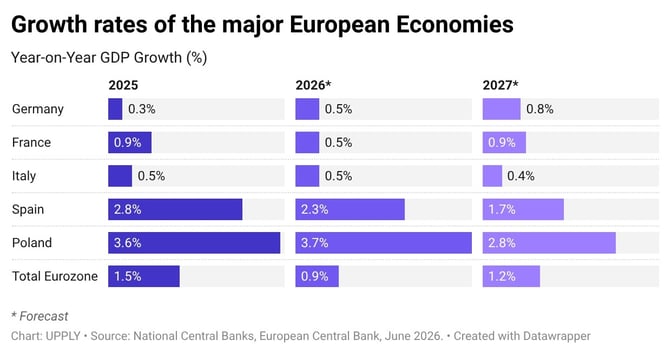
"As a net energy importer, the European Union's economy remains highly vulnerable to external disruptions, facing its second major energy shock in less than five years due to conflict and tensions in the Middle East. The surge in energy prices is resulting in higher bills for households and higher costs for businesses, which are reducing the profits of many industries," the European Commission points out. Furthermore, by reviving inflation, the conflict will weigh on the conditions for financing investments, which will also penalise businesses.
A new surge in inflation
The disinflationary movement in Western economies was abruptly interrupted by the conflict in Iran, due to soaring energy prices, but also to the prices of certain essential agricultural and industrial inputs produced massively in the economies of the Persian Gulf. Inflation thus rose sharply again in the euro area in the spring of 2026 (up to 3.2% in May) before falling back to 2.8-2.9%. The United States experienced a more pronounced acceleration over the same period, peaking at 4.2% in May 2026, before falling back to 3.4% in July. China, finally, emerged from the deflation observed in the summer of 2025 to return to positive territory from October 2025, stabilising around 1.0% to 1.3% since the beginning of 2026.
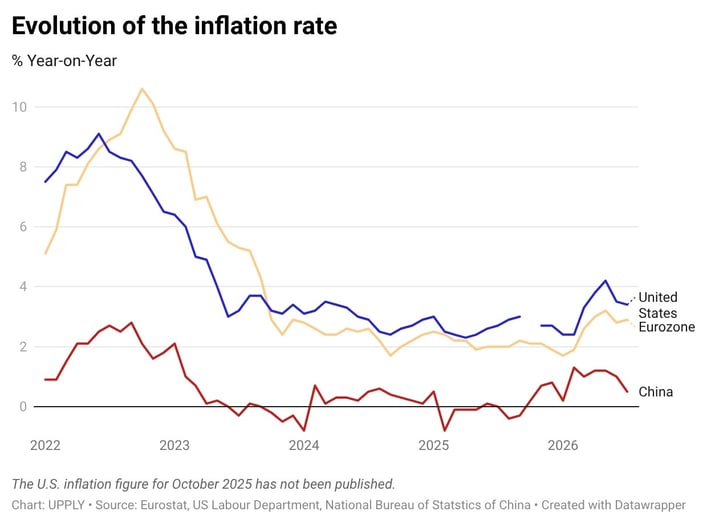
According to World Bank forecasts, global inflation is expected to reach 4.0% this year, compared to 3.3% in 2025. A more pessimistic scenario is not excluded, with the World Bank suggesting global GDP growth limited to 1.3% and inflation to 4.4% in the event of a deterioration of the situation in the Persian Gulf. It appears evident in any case that the inflationary effects will continue for some time, even if there is a calming of the situation, because the increase in the prices of raw materials and inputs, particularly agricultural ones, will be reflected in consumer prices in the coming months.
Global trade in a state of flux
2026 seemed to be shaping up under favourable auspices for global trade in goods. At the beginning of the year, the development of AI boosted demand for technological products more than expected, and the trade war over tariffs, which had marked the year 2025, seemed to be easing up. According to data from the World Trade Organization, The seasonally adjusted volume of world merchandise trade increased by 1.9% in the first quarter compared to the previous quarter and by 3.2% year-on-year. In value terms, the increase reached 2% quarter-on-quarter and 11% year-on-year.
These results are all the more satisfactory given that the base for comparison is high, since in the first quarter of 2025, activity was stimulated by advance orders, with companies accelerating orders before the increases in tariffs
But following the outbreak of the conflict in the Middle East, the outlook becomes more uncertain. Global trade growth is expected to "slow down in the second and third quarters of this year, due to a sharp contraction in trade with Gulf economies and rising energy and transport costs," according to the OECD. It is expected to fall to 3.1% in 2026 and 2.9% in 2027, against 5.0% in 2025.
Here again, the disparities will be significant. The OECD estimates that export volumes will increase by 6.5% for China and the dynamic economies of Asia, while in Europe, "rising energy prices and weak AI-related exports will weaken trade growth in 2026, which is expected to be less than half the level of 2025, before recovering in 2027." Finally, in the United States, the reduction of tariffs and uncertainty related to trade policy could gradually boost trade, but the strategy remains quite unpredictable.
A new level for transport prices
By causing a rise in energy prices, the conflict in the Middle East has had a rapid impact on freight transport prices.
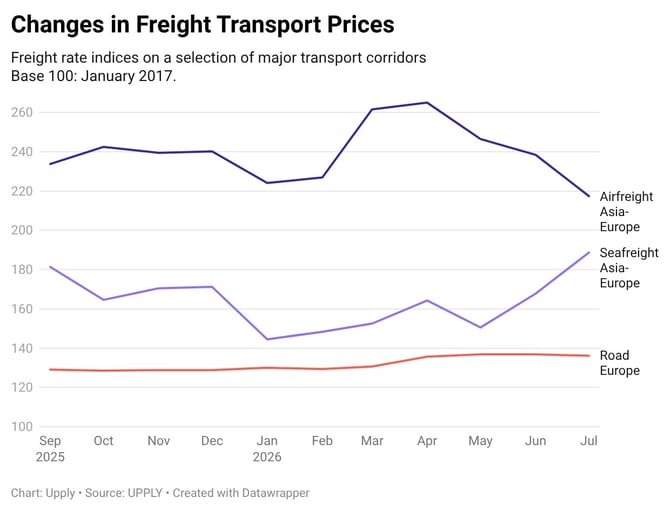
- The increase was particularly marked in air transport which, in addition to suffering from the rise in the price of kerosene, experienced direct disruptions: Middle Eastern airlines suspended their services before beginning to gradually reintroduce them, and major Middle Eastern air hubs were paralysed. This led to a contraction in capacity, which in turn drove up prices. The pressure is easing as capacity returns to the market, but demand for air freight is supported by promising sectors such as AI-related technology products. This should compensate for the relative slowdown observed in the cross-border e-commerce sector, and therefore contain the decline in freight rates in the coming months.
- In maritime transport too, prices have started to rise again, and after a slight lull in May, an early high season and careful management of capacity by shipping companies have pushed rates back up. This trend is now complete. A downturn could occur in the second half of the year, but the increase in operating costs for shipping companies should limit its extent.
- In road freight transport in Europe, prices also increased in March before reaching a plateau. Demand is generally quite weak, but given the low margins in the sector, carriers cannot afford not to pass on the increases in operating costs. It is therefore likely that this high level will be maintained in the coming months.
The situation in the Middle East will obviously be a decisive factor in the evolution of transport prices in the second half of 2026. Nothing suggests a rapid easing of tensions at present, although the upcoming US elections could lead to unexpected changes in direction.