The surge in diesel prices since the outbreak of the conflict in Iran has severely impacted the cash flow of road freight carriers. Anxiety and anger are rising, as European states respond in an uncoordinated fashion.
Donald Trump had announced a campaign of strikes lasting just a few weeks. But as we approach the last quarter of the year, it is clear that the conflict in Iran has become bogged down since it began on February 28, 2026. The resulting blockade of the Strait of Hormuz, along with the damage to the region's oil infrastructure, produced a major inflation in oil prices. The price of a barrel of Brent crude rose from $72 to $109 on April 7, exceeded $110 in early May and peaked at $128 in September.
Diesel is particularly affected by inflationary pressures
According to a report by UBS bank, transport activities account for just over half of global oil consumption, with road freight transport accounting for 18%. The shock is direct and massive for the sector.
This is even more true given that diesel, which is widely used in road freight transport, is experiencing particularly high inflation. During the summer, in particular, the trajectory of diesel prices remained upward in most major European economies, while the price of Brent remained stagnant.
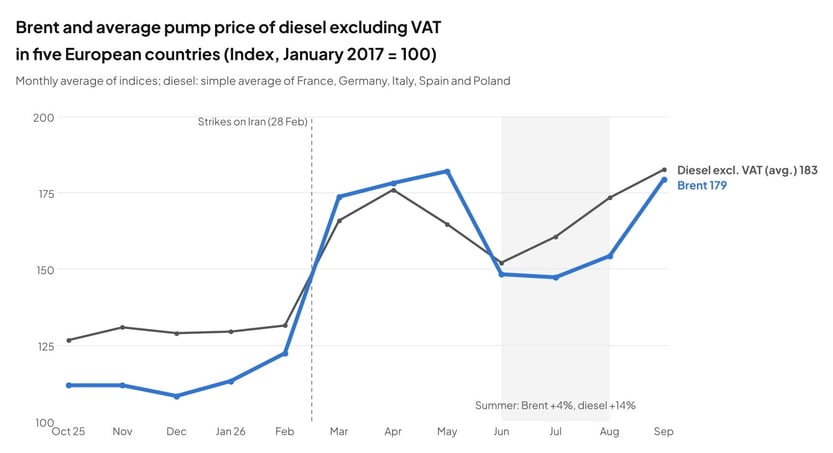
Data sources : European Commission (diesel excluding VAT), ICE (Brent) – Upply Data Hub, export of 05/10/2026.
Europe is proving to be particularly vulnerable. Faced with market tensions, it has very little room for manoeuvre because the production capacities of its refineries have significantly decreased in recent years. "Since the end of February, whilst the price of a barrel of crude has risen by 46%, diesel prices have soared by 100% in Europe and by 76% in the United States,” notes BNP Paribas in an economic outlook report published on October 1st. The surge in prices is very clear in the main economies of the European Union.
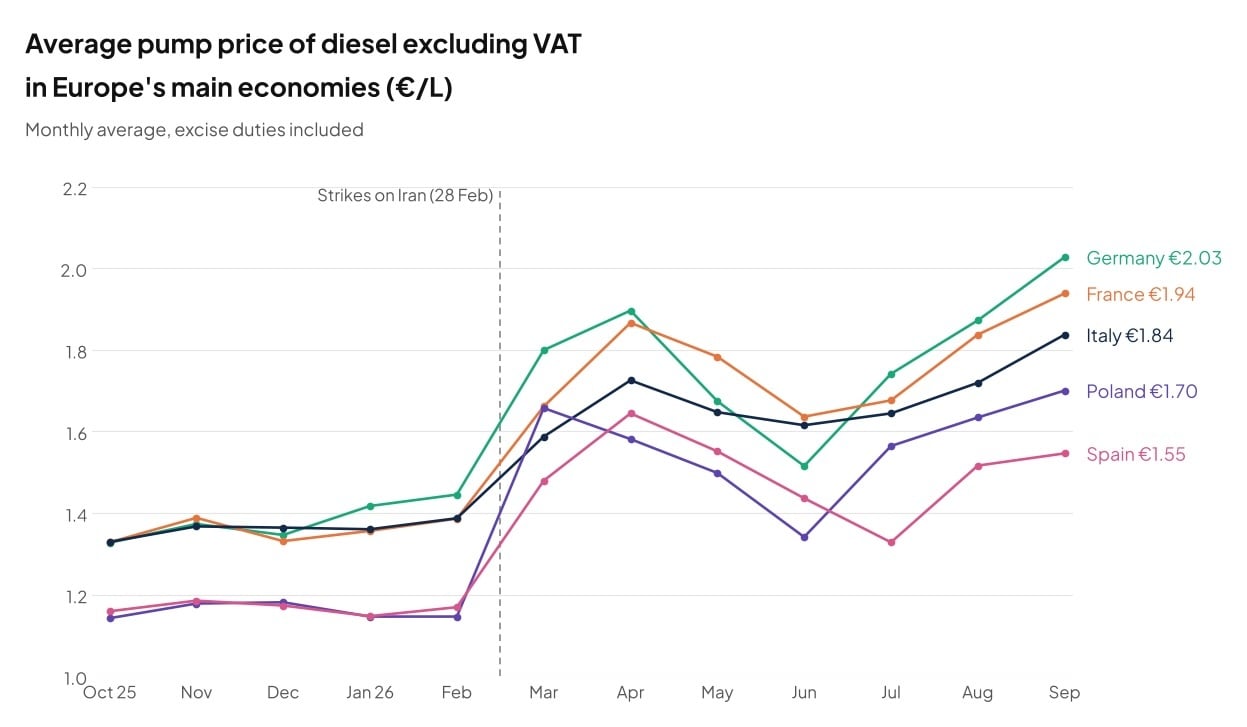
Data sources : European Commission (diesel excluding VAT), ICE (Brent) - Monthly average of indices, Upply Data Hub, export of 05/10/2026.
Depending on the country and the type of activity, fuel normally accounts for between 20% and 30% of the total operating costs of a heavy goods vehicle in Europe. Since net margins in the sector are low, generally between 1% and 3%, carriers strive to pass the extra cost on to the customer. For them, it's a matter of survival. But there is always a delay in this impact, which puts a strain on companies' cash flow. Moreover, the full pass-through of additional costs is not always effective, far from it, which also erodes the financial strength of road carriers.
Rising demands
To help carriers get through this phase, the European Commission has put in place the "Middle East crisis Temporary State Aid Framework" (METSAF). This framework allows Member States to put in place exceptional support measures in certain sectors particularly affected by the consequences of the conflict, including road freight transport. However, the financing of the measures is provided by the States, and not by the European Union budget. The room for manoeuvre is therefore not the same everywhere, and this is reflected in the mechanisms put in place, with governments making decisions based on their priorities and resources. Let's examine the situation in the countries hosting the top 5 European nationally-flagged road fleets.
The government has put in place a mechanism of direct aid per vehicle ranging from €100 to €500 per month for vehicles over 3.5 t depending on the category, capped at €60,000 per company and subject to tax and financial criteria. Three waves of measures have been launched[1]. In addition to this, there are deferrals of social and tax deadlines, and exceptional short-term loans via the public investment bank, BPI.
According to information revealed by the Minister of Transport, Philippe Tabarot, in a video broadcast at the FNTR congress on October 7, 11,000 applications were registered during the first wave, then 1,500 during the second. The payment rate reached 85% for the first and 34% for the second as of October 8th. The platform for collecting applications under the 3rd wave was opened on October 5th. According to the minister, 200 million euros will be mobilised in support of the sector through these various mechanisms, and 68 million euros have already been paid out.
On the other hand, road transport has for the time being been excluded from the extension of aid decided at the end of September for certain sectors, with the government referring road transport professionals to the mechanism of passing on the increase in diesel to the bills.
⇒ The professionals' response: the FNTR and the OTRE, professional federations representing road carriers, reacted strongly to this announcement. They are demanding not only an extension of aid, but also a reduction in taxes on professional fuels for the duration of the crisis and a simplification of the fuel indexation mechanism. The professional federations do not rule out a protest movement if they are not heard. The TLF trade union also insists on the need to enforce the legal framework on payment deadlines. All the federations also deplore the processing times for applications, which are not in line with the urgency of replenishing cash reserves.
The Spanish government implemented an initial aid package in March 2026, establishing a discount on professional diesel, in addition to the general reduction in excise duty, as well as a lump sum payment for vehicles not eligible for this reimbursement (€1,800 per truck over 7.5 t). This scheme was then extended a first time to cover the third quarter. A third decree-law[2], adopted on September 29, extended aid a second time until December 31. The excise tax will decrease from 20 cents per litre of diesel in October 2026 to 13 cents in November and 6 cents in December with an automatic reactivation clause in case of a sharp price increase, offset by an increasing discount on professional diesel.
⇒ The professionals' response: In Spain, federations are less critical of the principle of aid than of its implementation. The Fenadismer federation is therefore advocating for aid to be paid directly to carriers. CETM, for its part, considers the amounts "clearly insufficient". It also demands the immediate payment of aid from the first package, which many SMEs are still waiting for.
No targeted aid for carriers has been put in place. The government has opted for a general reduction in the energy tax, the "Tankrabatt": 14 cents per litre excluding VAT (approximately 17 cents including VAT) in May and June. The scheme was reactivated from the 1st of October and until the end of the year[3].
⇒ The professionals' response: in an open letter to Chancellor Friedrich Merz on September 16, the BGL calls for the creation of professional diesel supply, on the model of France or Spain, and the end of double CO₂ taxation (national quotas and heavy goods vehicle tolls).
The general "CPN" (Lower Fuel Prices) program, renewed from October 3rd to December 31st [4], provides that the VAT rate on petrol, diesel and biocomponents constituting pure fuels is temporarily reduced from 23% to 8%. Furthermore, the excise tax on fuels has been reduced to the lowest level allowed by the European Union, according to a statement from the Polish Ministry of Finance.
⇒ The professionals' response: the professional association ZMPD wrote on October 1st to Prime Minister Donald Tusk and the Ministers of Finance and Infrastructure. It calls for direct subsidies per vehicle, within the European framework of METSAF, financed by the tax on oil superprofits, which the government has for the time being chosen to dedicate to the general reduction of prices at the pump.
A temporary reduction in the excise tax on diesel fuel has been in place since March 19th, extended several times, then gradually reduced from September 18th and expiring on October 5th[5]. The "mobile excise" mechanism mentioned as a possible replacement has not been activated to date, according to the specialised press. Carriers also benefit from tax credits proportional to the additional cost of diesel compared to February 2026. Initially planned from March to May for an amount of €100 million, it was extended in stages until October, with the budget increased to €300 million in May and then supplemented several times. The government announced the first payments will begin on October 20th.
⇒ The professionals' response: In a rare move, all the transport and logistics federations (ANITA, FAI, Unatras, Confartigianato Trasporti, CNA-FITA, Assotir, Trasportounito…) sent a joint letter on October 1st to Giorgia Meloni and the Ministers of Transport and Economy to demand an emergency meeting. They are asking what measures will take over from the excise tax reduction after October 6 and for an extension of the tax credit. They also denounce the fact that the price reductions granted at the pump by some oil companies are not reflected in wholesale purchases, outside of stations, on which most transporters depend, and ask the government to put pressure on the oil companies. They are finally demanding the implementation of the protocol signed on May 22: payment of promised aid, creation of a consultation body for the sector and implementation of the €590 million fund for fleet renewal.
CONCLUSION
As the new academic year begins, concerns are growing among professional federations across Europe. Most governments are extending their measures for the last quarter, but one observation is clear: on the one hand, the pass-through of the increase in diesel is difficult and partial, especially for small businesses, even when indexation mechanisms exist. On the other hand, the administrative management of aid leads to significant delays before actual payments are made, which puts a strain on companies' cash flow.
From one country to another, the demands are converging. The industry is calling for targeted aid, harmonised professional diesel fuel across Europe, and a binding indexation of rates to the price of diesel fuel. As rising fuel prices become a long-term trend, exasperation is growing among carriers, who fear a wave of bankruptcies.
[1] Sources: Decree No. 2026-289 of April 17, 2026 (1st wave), Decree No. 2026-591 of July 3, 2026 (2nd wave), Decree No. 2026-885 of September 23, 2026 (3rd wave)
[2] Sources: Royal Decree-Law No. 7/2026 of March 20 2026 (1st wave), Royal Decree-Law No. 18/2026 of June 29, 2026 (2nd wave), Royal Decree-Law No. 25/2026 of September 29, 2026 (3rd wave)
[3] Sources: Second law amending the energy tax law to temporarily reduce the fuel tax, Bundestag vote on extension.
[4] Sources : adoption of the CPN program, extension of the CPN program.
[5] Sources: decree-law of March 18, 2026, Press release from the Council of Ministers of September 16, 2026.