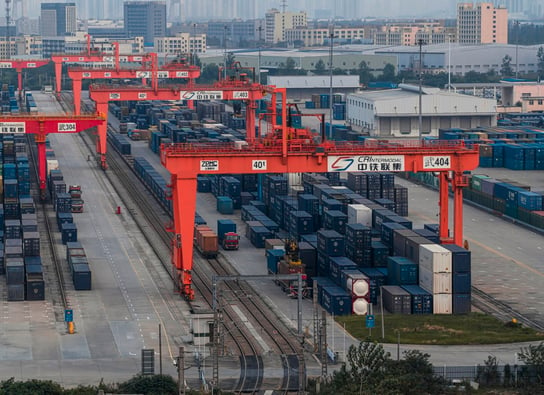
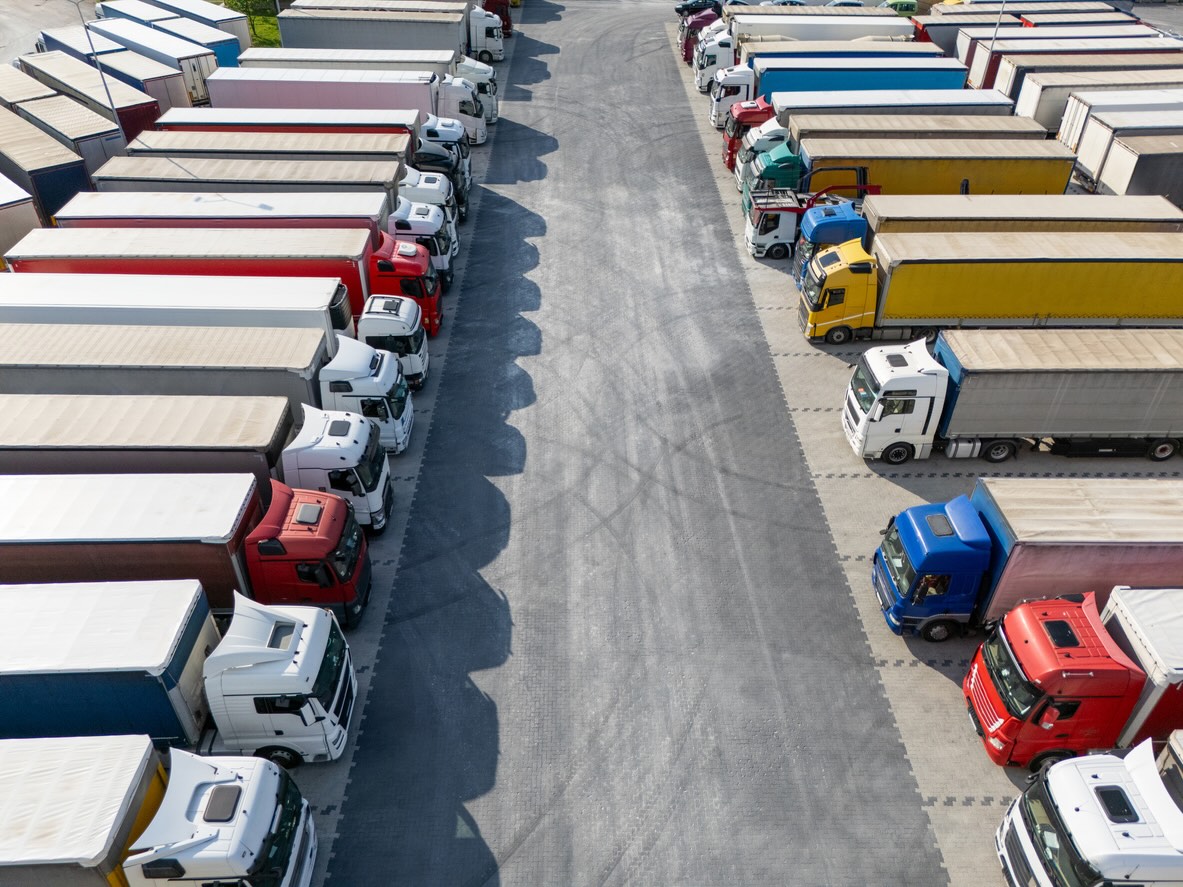
China-EU rail freight volumes via the Northern Corridor jumped 39% in the first half of 2026, boosted by the dynamism of Chinese exports and disruptions to maritime transport.
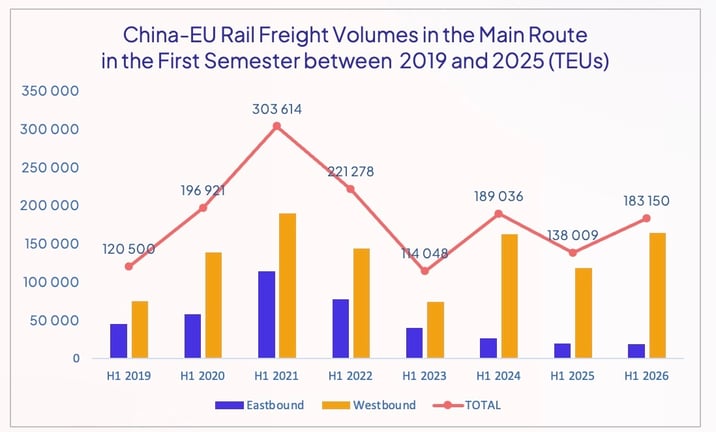
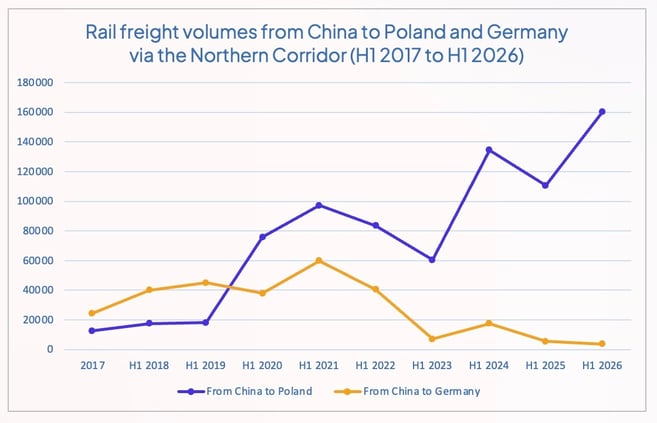
According to data from the operator European Rail Alliance, which measures rail freight volumes between China and the European Union via the Northern Corridor, Rail freight between China and Europe rebounded sharply in the first half of 2026. Total traffic reached 183,150 TEUs, a 32.7% increase compared to the same period in 2025.
Source : ERAI
The main findings
- East-West rail traffic increased by 38.9% to reach 164,336 TEUs. This is the best result since 2021, a year marked by a strong post-Covid recovery that boosted traffic.
- In the other direction, rail freight traffic continues its inexorable decline. By falling back by a further 4.6%, it reached the almost derisory figure of 18,814 TEUs.
- The asymmetry of flows widens even further as volumes leaving China represent 90% of the total in the first half of 2026, confirming that it is primarily a tool serving Chinese exports.
- Between 2019 and 2026, the total volume of the first half of the year experienced an average annual growth rate of 6.2%, but this global increase masks diverging trajectories: West-East flows increased by an average of 11.8% per year during this period, while in the other direction, they declined by 11.8%.
Factors influencing developments in the first half of 2026
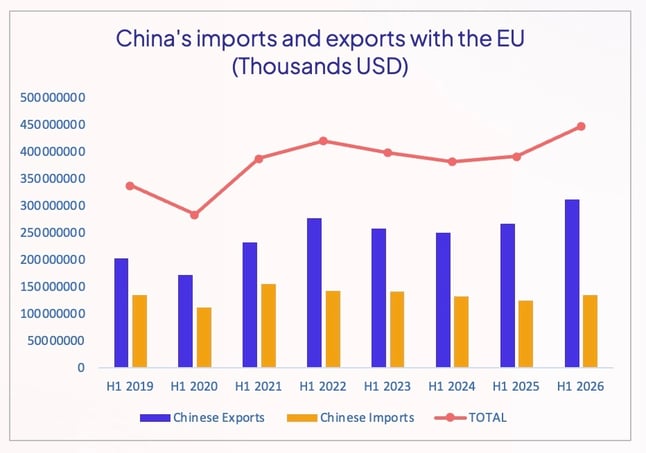
The evolution of China-Europe rail freight flows in the first half of 2026 is partially aligned with the trajectory of trade. During this period, Chinese exports to the European Union increased by 16.8% in value, reaching $448 billion, while imports simultaneously increased by 8.8%, to $135.5 billion.
- In the West-East direction, rail freight can be a valuable complement to maritime or air freight, especially in times of crisis. However, in the first half of 2026, international transport was precisely disrupted by the outbreak of war in the Middle East, which probably steered some shippers towards rail transport.
- Conversely, the more moderate growth of Chinese imports has no impact on rail flows, as maritime capacity is largely sufficient and at very competitive prices.
Content source : Chinese Customs
- In the East-West direction, the concentration of rail freight flows on the China-Poland route increased further in the first half of the year, as this route represents 97.6% of the volumes on the northern corridor. This can be explained by the overall dynamism of the Polish economy, which has one of the best growth rates in the Eurozone, but also by the development of new logistics schemes by Chinese e-commerce platforms. These companies are now establishing logistics warehouses to serve the European market, and are finding a favourable ecosystem in Poland.
Source : ERAI