FORWARD THINKING. Faced with an increase in geopolitical and climatic tension, traditional shipping routes are under threat. Here, we consider the pros and cons of setting up a new W-shaped global traffic model as part of a deep-sea network enabling high-risk areas to be avoided as far as possible.
Low water levels in the Panama Canal. War in the Black Sea. The threat of Houthi attacks in the Bab el-Mandeb Strait. Traffic blocked in the Strait of Hormuz, with the possibility that the same could happen in future in the Malacca and Taiwan straits. In recent years, there has been an increase in the number of obstacles to the free movement of goods by sea, whether for geopolitical or climatic reasons.
In this new situation, it seems increasingly clear that the organisation of container shipping lines, which has emerged from over 30 “happy” years of globalisation, is becoming obsolete.
A new organisation of lines and capacity
With the risks posed by maritime trade hotspots once again cruelly highlighted by the Middle East war, we have decided to carry out a forward-looking exercise by imagining a deep-sea network for 18,000-24,000 TEU vessels passing only through open seas and thus avoiding bottlenecks in the form of straits and canals.
In line with this idea, smaller container ships would have two possible roles:
- 2,000 – 10,000 TEU vessels would serve as feeders in and out of bigger hubs with denser networks. They would serve the local intra-regional market, as well as providing first and last-leg trans-oceanic transport.
- 10,000 – 15,000 TEU vessels would be deployed to provide premium and high-speed services on shorter, classical deep-sea routes.
This approach involves separating capacity for use on two different kinds of service:
- Slow, high-volume, long-distance services on major corridors.
- Higher quality services prioritising point-to-point transport using the shortest possible routes.
From V-shaped to W-shaped
Adaptation and anticipation are the historical foundations of merchant shipping. The shipping companies have shown themselves to be particularly agile in this respect, moreover.
This was demonstrated by their reaction to the attacks carried out by Yemen’s Houthi rebels in late 2023 in the Bab el-Mandeb Strait. The shipping companies got round this obstacle by diverting ships wholesale round the Cape of Good Hope. The decision to use this route, which follows a perfect V-shape round the African coast, to replace the traditional, shorter Suez Canal route between Asia and Europe, has been comforted by the start of the war in Iran.
Given the huge success of the Cape of Good Hope route, which is used by the great majority of vessels of more than 15,000 TEU, and according to the same logic, one can imagine setting up another V-shaped route round Cape Horn. This would create a global traffic system in the form of a W, which would keep clear of the main current and potential future hotspots.
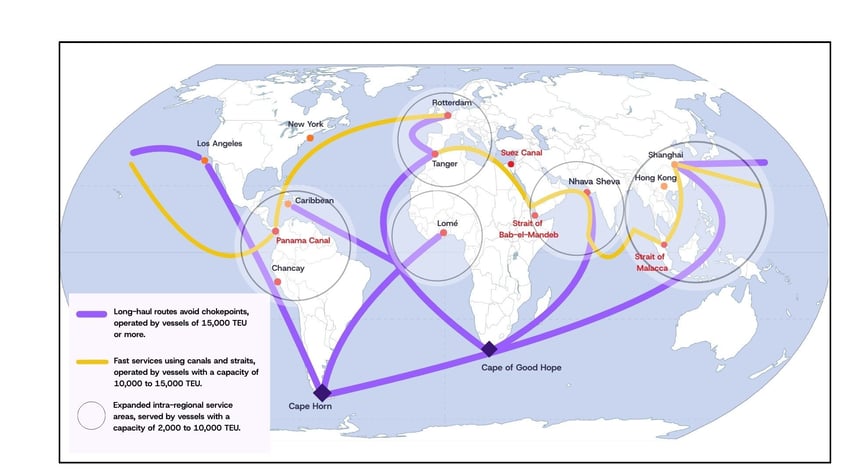
Map created by the author - © Upply
The resemblance between this map and marine maps of the early 19th century is not a coincidence, since the Panama and Suez canals would no longer be used for the high-volume traffic handled by the 15,000 TEU-plus ships.
The W-shaped route would become a sort of central nervous system, connected to a dense capillary-style network via hubs served by smaller ships. The logic would be comparable to that behind the short-sea routes which currently exist in the intra-Asian trades.
This structure would generate new costs, longer transit times and a deterioration in carbon-reduction performance. Its robustness would, however, enable it to provide a partial response to current security problems, as well as taking account of the development prospects of Africa and Latin America in the present BRICS growth era.
The example of the Cape of Good Hope route, which is now considered to be a long-term option, is a perfect example of the post-Covid “new normal” which the market is currently getting used to. What should have been seen as a regression has become, if not the best solution, at least the most acceptable one in terms of service, price and security. Shippers have learned to live with it and the shipping companies have also benefited from it, since the unwanted change it represents has enabled them to partially counterbalance their endemic overcapacity.
Such unobstructed routes could also help to restore service frequency and regularity, even if the particular risk of sailing round the capes in winter should not be minimised. For the shippers, they would represent the possibility of more reliable transit times, and, for the shipping companies, better use of their giant ships and a welcome absorption of current and future capacity shocks. Finally, the risk mitigation they bring could benefit both sides in terms of lower insurance premiums.
Another collateral factor, which could become important in the years to come, is that a W-shaped traffic structure could make nuclear-powered container ships more acceptable at a time when projects for such ships are starting to emerge.
Impact on the major shipping routes
- On transatlantic routes, the new configuration would not result in major changes in so far as they already operate to a large extent on open seas. The exception is the English Channel, which some observers consider to be a bottleneck. At this stage, we have deliberately excluded it from our list of hotspots.
- In the transpacific market, Asia-US West Coast services, which represent the bulk of traffic, will not be greatly changed. That said, the W-shaped configuration of the new system would make it even more necessary for American ports to modernise their installations if they are to accommodate large numbers of 18,000 TEU-plus ships without congestion. Still in the Pacific, for Asia-Latin American East Coast services, the hub which was inaugurated in the Peruvian port of Chancay in Novembre 2024, would come into its own.
- As well as receiving transatlantic traffic, the US East Coast and the Latin American East Coast would be served by a Caribbean hub, which would receive traffic of East Asian origin via Cape Horn and traffic from western Asia and India via the Cape of Good Hope, as it already does in some cases today.
- In Asia, the blackspots represented by the Malacca and the Taiwan straits could be deliberately bypassed, enabling Hong Kong to reclaim from Singapore the title of intra-Asian mega-hub.
A temporary or long-term model?
The W-shaped traffic system is a response to four current challenges by:
- Enabling ships to avoid risk areas.
- Positioning 18,000 TEU-plus ships on longer routes.
- Improving service quality by reducing operational risk.
- Separating low-cost from premium services, as is already the case in air transport.
At a time when merchant shipping’s freedom of navigation is being increasingly denied, even though it is a basic principle of international law, its “zero chokepoint” approach could be attractive in some quarters.
Two major obstacles stand in its way, however. On the one hand, MSC, Gemini, Ocean Alliance and Premier Alliance would all need to adopt the reconfiguration at the same time. This would clearly be the major obstacle. On the other, the environmental impact of such a reconfiguration would be in total opposition to global CO² emission reduction targets. That said, recent history has shown that international tensions and fossil fuel sobriety do not make good bedfellows.