Road freight transport is expected to register moderate growth in 2026, particularly if the improvement in the economic situation in Germany materialises. At the same time, the supply of transport remains under control and the pressure on costs is significant, which limits the impact of low volumes on the evolution of freight rates.
1/ A moderate economic recovery for Europe in 2026
Europe enters 2026 in a context of moderate recovery, which is uneven across countries and sectors. The latest forecasts from the European Commission, the European Central Bank, and the OECD converge on a GDP growth rate of 1.2% in 2026 for the euro area. For the European Union, the increase should be slightly higher, reaching +1.4% according to estimates from the European Commission. This growth remains modest compared to pre-pandemic years. According to the OECD, the average annual GDP growth between 2013 and 2019 was 1.9%. The current slowdown reflects the ongoing challenges related to inflation, geopolitical tensions, and the energy transition.
Disparities between member states are marked: Poland and Spain are expected to show the most dynamic growth (up to 3.5% for Poland), while France, Italy and Germany will remain behind, with rates below 1.5%.
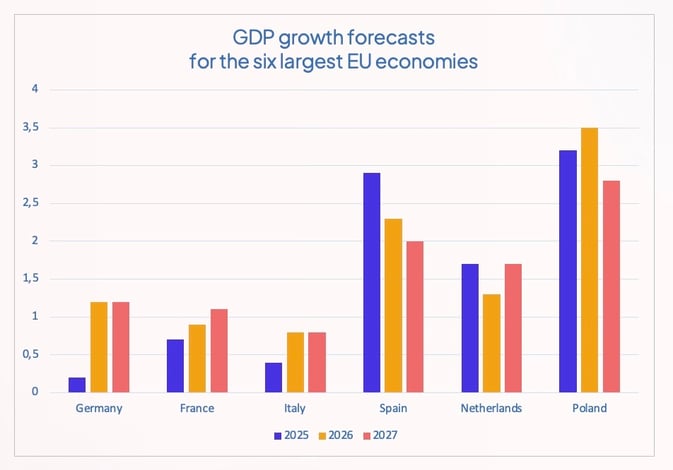
Content source: European Commission Autumn 2025 economic forecasts
Inflation as measured by the Harmonised Index of Consumer Prices is expected to fall from 2.1% in 2025 to 1.9% in 2026, thus meeting the ECB's target of 2%. Food inflation, in particular, should decrease significantly.
The unemployment rate, meanwhile, is expected to decrease slightly, from 6.3% in 2025 to 6.1% in 2026 in the euro area.
2/ Evolution of demand
According to the European Central Bank, domestic demand will remain the driving force of growth in the euro area in 2026, “bolstered by rising real wages and employment, in the context of resilient labour markets with record low unemployment rates."
Household consumption growth is expected to regain some momentum in the coming quarters, with annual growth rates of around 1.2% forecast for the period 2026-2028, which is broadly in line with the historical average. According to the ECB, this trend will be supported by the rise in real disposable income. However, the savings rate is expected to remain high due to increased economic uncertainty. Household demand will therefore have a positive effect on transport demand, but in moderate proportions.
Additional public spending on infrastructure and defence announced for 2025, particularly in Germany, as well as improved financing conditions resulting from cuts in key interest rates since June 2024, should also support growth. These factors will also likely benefit business investment, which is expected to continue to increase in 2026-2028. Demand for transport will therefore be stimulated by business investment and public spending, but probably more so from 2027 on than in 2026, where a certain wait-and-see approach remains in place given the very uncertain international environment.
3/ Impacts on road transport demand
By 2026, the transport sector in Europe will be profoundly transformed by the interaction of several major dynamics. In addition to the rise of e-commerce and the transition of the automotive sector towards electric vehicles, volumes will be influenced by the marked decline in the chemical sector, the decrease in fossil fuel transport, and conversely the recovery in the pharmaceutical sector (...)
CONTENTS
1/ A moderate economic recovery for Europe in 2026
2/ Evolution of demand
- Focus on the European automotive sector, a sector in crisis
- Growth in the services sector
3/ Impacts on road transport demand
4/ Evolution of freight rates
5/ The structural challenges of the sector
- Labour shortage is expected to worsen
- The 'stop and go' of environmental regulations
- Technological challenges
To read more and get the full report in PDF format, please enter your details.