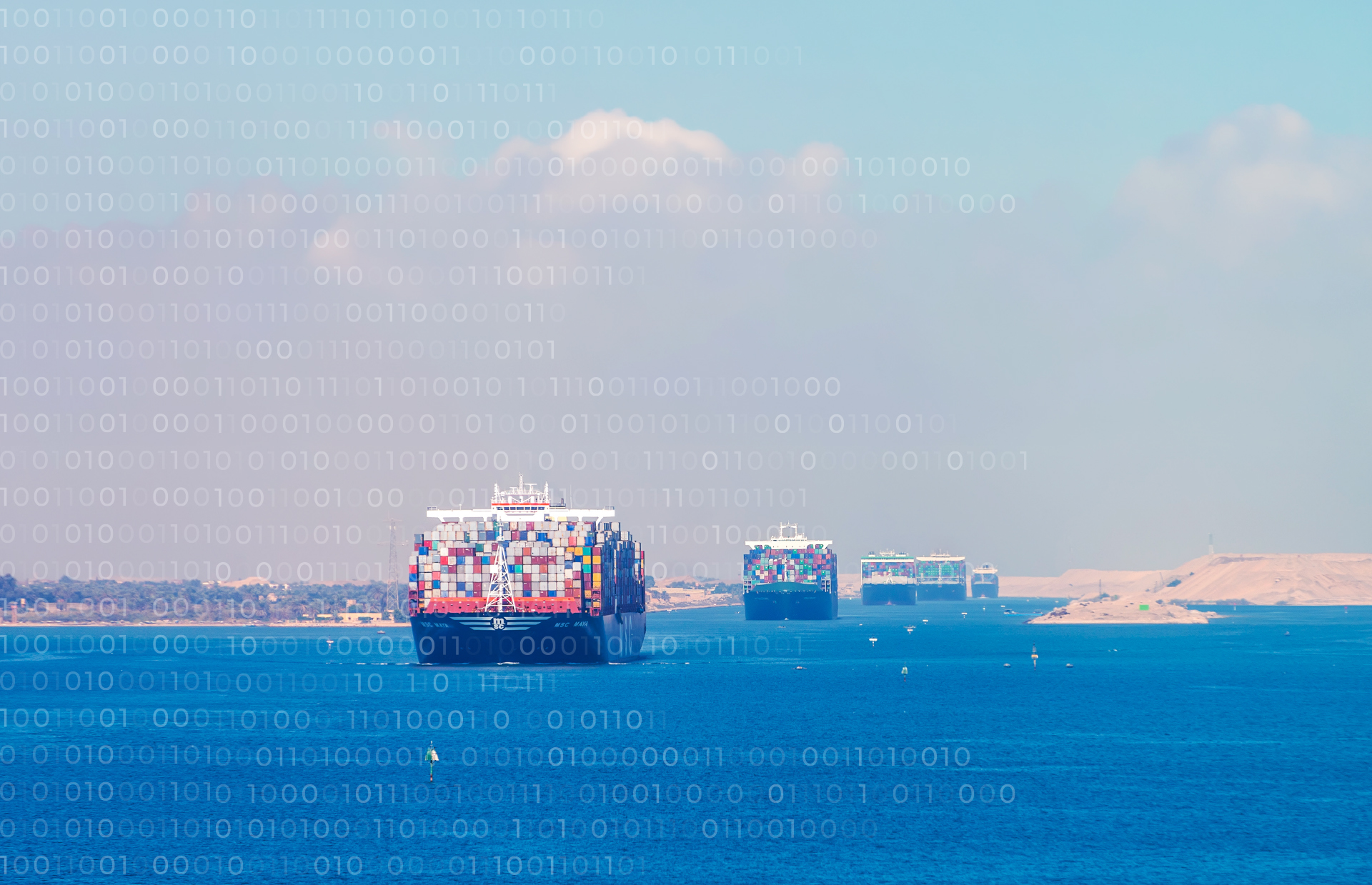
The question as to whether or not shipping will return to the Suez Canal is so fundamental that it is totally dominating discussion of the future of the container shipping sector in 2026.
The economic environment
In Europe, demand should remain fairly strong in early 2026, as it did in late 2026, driven as it was by the importation of Chinese products for the B to B and B to C markets. The switch of Chinese exports to the European market, backed by some aggressiveness on prices, is now an established fact, while Chinese domestic demand is marking time and the American market for Chinese goods has been markedly reduced.
The container shipping market is already suffering from structural overcapacity, which is likely to be aggravated as the number of new ships coming on to the market peaks between 2026 and 2028. For the last two years, the impact of this overcapacity has been dampened by the use of longer shipping services as ships generally went round the Cape of Good Hope, as well as by the blank sailings strategy used by the shipping companies. This situation is unlikely to last, however.
The geopolitical environment
- The China-US trade war and its collateral impact
The United States’ trade deficit with China has been reduced, while Europe’s has increased. Last year was marked by the introduction by the United States of huge customs duties on Chinese imports, followed by considerable backtracking on the part of the US on these same duties. In the same way, the measures due to be taken against Chinese ships were finally suspended. Although one might think that bilateral trade relations stabilised during the final quarter of 2025, the unpredictability of the Trump administration and its declared rivalry with China suggest that new disruption is not to be ruled out. The question of the taxation of Chinese ships will certainly come back on to the table since the taxes in question have only been suspended for a year.
Europe is struggling to break away from its original free trade DNA in favour of a more regulated approach to the market, of the kind adopted by the United States and China. It could change position in 2026, however, even if, in Europe, any such change always takes time. The position adopted by new European Union competition commissioner Teresa Ribeira on maritime issues in 2026 is keenly awaited.
- Conflicting pressures on decarbonisation
Last year came to a close with a bad signal from the International Maritime Organisation (IMO) on decarbonisation. Under American pressure, the IMO postponed the extraordinary session it had been due to hold to approve the Net Zero Framework it had drawn up with a view to reducing greenhouse gas emissions from ships.
It is probable that, in the meantime, pressure is going to be exercised to obtain a total revision of the way shipping companies access the emissions market. As it stands, the market uses a debit/credit system which is financially advantageous to shipping companies with a good emissions record and penalises those with less good records.
This project is in addition to the European Union Emissions Trading System, to which shipping has been a party since 1 January 2024 and which comes into effect progressively over three years. In 2026, the shipping companies must buy carbon quotas corresponding to 70% of their emissions in 2025, compared to 40% of their 2024 emissions in 2025. This progressive implementation will be all the more expensive for the shipping companies for the fact that the rerouting of their ships via the Cape of Good Hope has increased their emissions substantially by comparison with the Suez Canal route. Given that the shipping companies’ profit margins are already under pressure, it seems inevitable that the extra cost will be passed on to shippers.
CONTENTS
- Suez Canal/Cape of Good Hope: the shipping companies refuse to decide
- Scenario 2: escalating world conflict
- Scenario 3: a return to regulated freight rates
To read more and get the full report in PDF format, please enter your details.