SPECIAL REPORT 3/5. The Netherlands remains a key European logistics hub, combining historic trade strengths, world-class infrastructure, and rising constraints reshaping strategies for operators and investors.
Prior to engines and railways, the Netherlands laid the foundation for a major European logistics hub. Along the canals of Amsterdam, residences also functioned as integrated commercial units, with trading activities on the ground and storage facilities on the upper floor. Inbound goods originated by the Dutch East India Company shared the docks with barges carrying products to European customers, through a well-developed network of waterways.
A strategic gateway
History leaves a lasting mark! Nowadays, several global 3PLs have established operational headquarters and major warehousing footprints in the Netherlands, one of Europe’s most strategic logistics gateways. This position is supported by world-class infrastructure, including the Port of Rotterdam —Europe’s leading container port and the world’s twelfth largest— and Schiphol Airport, a key asset for air freight, ranking fourth in Europe.
That combination enables the country to serve as a central entry and redistribution point for a wide variety of goods flowing in and out of EU. The product mix and relatively short distance from main consumers and producers creates competitive advantage among other industrial hubs as shown in the table below.
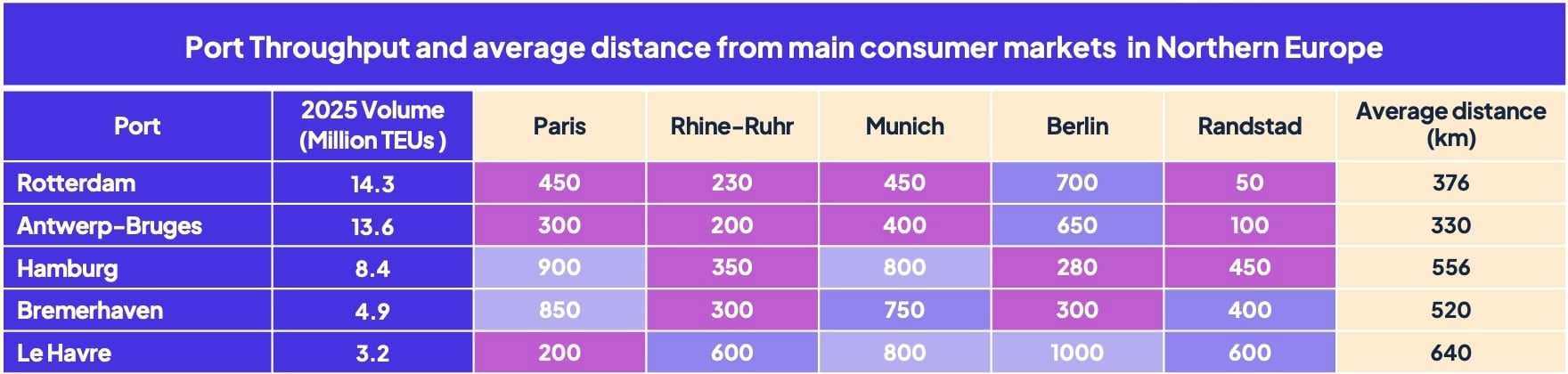
Source: Port Authorities, elaborated by author.
On top of the good location, the country’s long-standing tradition of trade and distribution makes it an attractive destination for supply chain professionals, combining transportation, procurement and SC planning teams from a wide range of industries: FMCG, Electronics, Fashion and others. The strong interdependency between Benelux ports is the main driver to understand the logistics landscape and importance for Northern Europe industry.
Growing constraints
Despite these advantages, the logistics and warehousing sector is now entering a more complex phase. Prime logistics locations such as Rotterdam, Schiphol, and key inland hubs are increasingly constrained by land scarcity, environmental regulation, and grid capacity limitations. New logistics developments are structurally constrained. This has led to a shortage of high-quality logistics space, while vacancy remains concentrated in older, less efficient assets.
Moreover, according to CBRE, bottlenecks in the logistics labour market are more pronounced than in other sectors. Faced with a labour shortage, the industry already relies heavily on migrant workers, and regulatory tightening of this workforce is expected to intensify. This strain is driving up labour costs.
As a result, companies are seeking to accelerate the adoption of automation and robotisation. Modern warehouses require higher specifications to support automated operations and efficiency gains, necessitates substantial upfront capital and favours economies of scale, driving consolidation.
More selective investors
This shift translates directly into real estate demand. Overall demand remains resilient, at around 3.8 million square metres, confirming the attractiveness and liquidity of the logistics market. However, investors are becoming increasingly selective, focusing on high-quality assets located in prime locations.
- The requirement is specifically for Grade A distribution centres, meaning facilities equipped with advanced technical specifications: high clear height (typically 12m+), floor load capacity, power supply, layout flexibility to accommodate Automated Guided Vehicles (AGVs), robotic pick-and-place systems, and automated sorting lines.
- The loss of competitiveness of older warehouses, regardless of their location, is driving an increase in vacancy rates, which are expected to have exceeded 5.7% in 2025.
In numerical terms, the table below shows the main developments in 2025 by main advisors (CBRE, Knight Frank and Cushman & Wakefield). Investments in industrial and logistics ranged from €2.5-€3.1 billion, representing 34% of Dutch commercial real estate. According to Knight Frank, Amsterdam is forecast to record one of the strongest growth rates in Europe at 4.4% CAGR over the next five years, with Rotterdam at 3.9%, both ahead of the 3.5% average across major European markets.
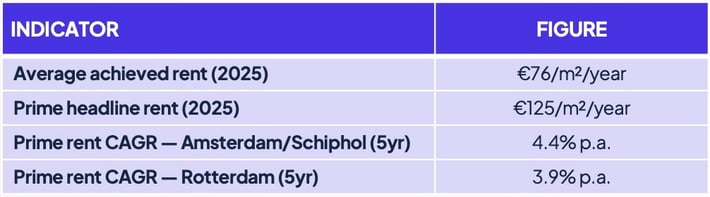
Sources: JLL, Cushman & Wakefield, Knight Frank.
Scarcity driven by space constraints also supports rental levels and yields. Prime Net Initial Yields have stabilised around 4.6%–4.75% in 2025, reflecting continued confidence in the sector, even amid broader macroeconomic uncertainty. Net Initial Yields in the core segment ranges between 4.75% and 5.00%.
Employment trends
Demographic trends also provide important signals on market dynamics. Employment in the “Warehousing, services for transport” sector has increased by around 38% over the past decade, while total compensation rose by 73% over the same period.
Another notable development is the growth of the female workforce, with approximately 14,000 additional positions filled in the last 10 years, increasing its share from 24% in 2015 to 29% of total employment. This shift suggests that technological adoption may be contributing to a more inclusive work environment, while also increasing throughput with a reduced reliance on manual labour.
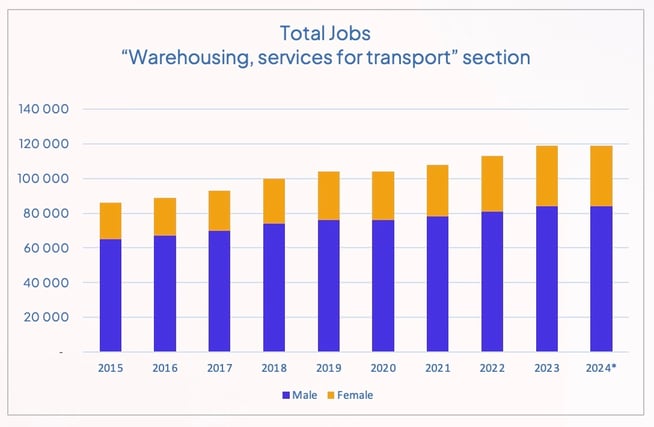
Source: CBS
An evolution rather than a transformation
Supply chain diversification, nearshoring, and the continued growth of e-commerce are sustaining demand for logistics space. At the same time, regulatory changes like the removal of the EU’s de minimis threshold, are expected to shift distribution models away from direct-to-consumer imports from Asia toward more consolidated, Europe-based fulfilment networks. This transition is likely to increase demand for large-scale, modern warehouses within key hubs.
In this evolving landscape, the Netherlands continues to benefit from its strategic location and integrated logistics system. To support growth, the government continues to support the sector through policies and incentives maintain its position. With a public debt of 44% of GDP and exports accounting for around 75-80% of GDP (CBS), the country has a strong advantage against neighbours.
Prime logistics hotspots are not necessarily adjacent to major cities, the compactness and high road connectivity mean a warehouse in Venlo or Tilburg can reach Amsterdam, Rotterdam, and the German border in comparable drive times. Demand is concentrated along a north-south corridor running from Rotterdam through Brabant and Limburg to Venlo. All Major global 3PLs are present, and investment continues. For example, DSV has recently commissioned a 240,000 sqm XXL warehouse in the Moerdijk logistics park. Around 80% of relocations are driven by the desire to upgrade.
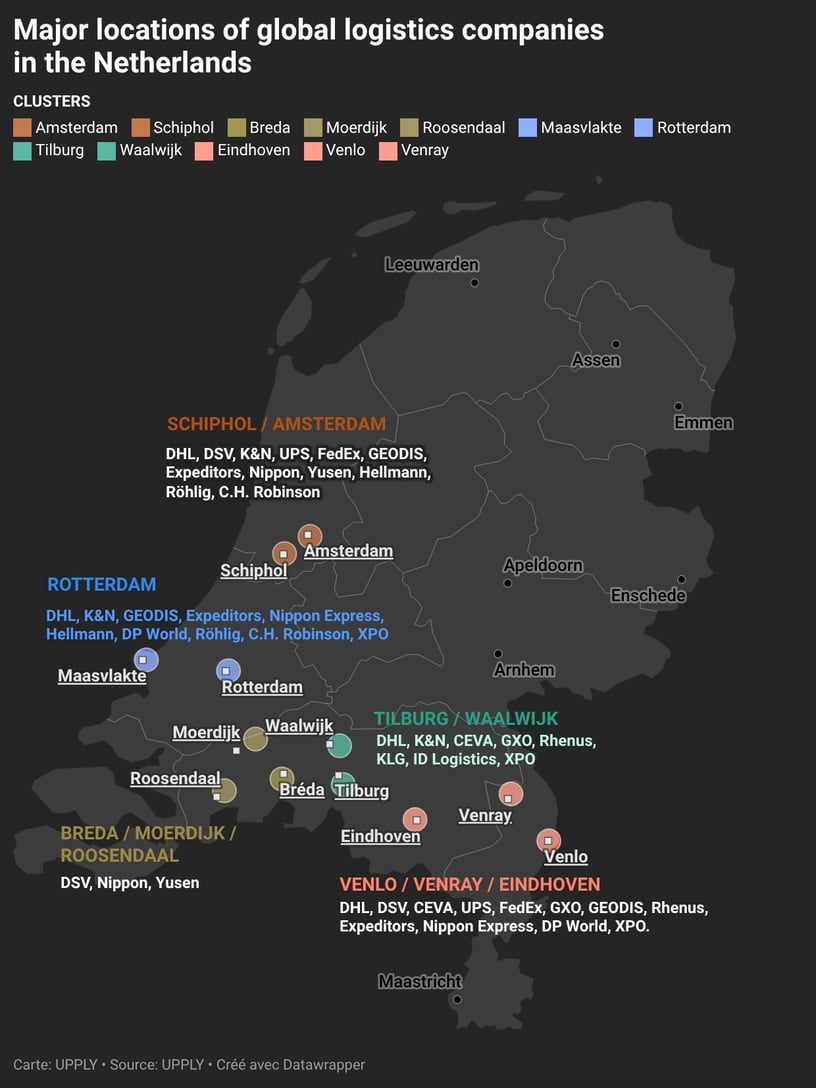
- Venlo / Venray / Eindhoven: this area is consistently ranked among Europe's top logistics locations. Positioned at the tri-border junction, with direct motorway access via A73/A67 and rail links into Germany, it offers proximity to the continent's largest consumer market. Trade Port Venlo Noord hosts European distribution centres for Michael Kors, Tommy Hilfiger, Calvin Klein, and Under Armour. Vacancy in the Venlo-Venray region remained at approximately 1.5% in 2024, even as national vacancy rose to its highest point since 2015 (CBRE).
- Tilburg / Waalwijk: this area has emerged as dominant e-commerce fulfilment hub. Its geographic centrality (equidistant between Rotterdam, Antwerp, and the German Ruhr) combined with rail and road terminals has attracted a concentration of XXL distribution centres (100,000 sqm+), many highly automated. Vacancy in Tilburg-Waalwijk was also approximately 1.5% in 2024. JLL noted that a single Tilburg property marketed to a strong tenant received over 20 bids, illustrating the competitive tension in this sub-market.
- West-Brabant (Breda / Moerdijk / Roosendaal): serves road-based distribution toward Belgium and southern markets (A16/A27), as well as barge and short-sea, linked import flows via Moerdijk's industrial port. Lidl established its European e-commerce DC in the Roosendaal area. GetTransport summarises the operational model of this cluster as follows: Tilburg provides rail-backed consolidation for Rotterdam, Moerdijk offers on-terminal bonded warehouses, simplifying customs clearance, and Breda provides agile regional road distribution toward Belgium.
- Schiphol Corridor & Amsterdam: This area is naturally specialised in air freight-adjacent operations: pharma, high-value goods, e-commerce and time-sensitive distribution. Space is constrained and rents are among the highest in the country (Knight Frank).
Ultimately, the Netherlands is not simply a logistics market, it is a system that enables the movement of goods across Europe. The interplay between traders in Amsterdam and logistics operators from Rotterdam remains core to this culture. The challenge ahead lies in sustaining this model under increasingly complex economic, regulatory, and spatial conditions.