Global air cargo has demonstrated an adaptability that has enabled it to register further good volume growth in 2025. In 2026, growth is expected to slow significantly, but companies should be able to contain profit margin erosion, as in 2025.
1/ The evolution of supply and demand
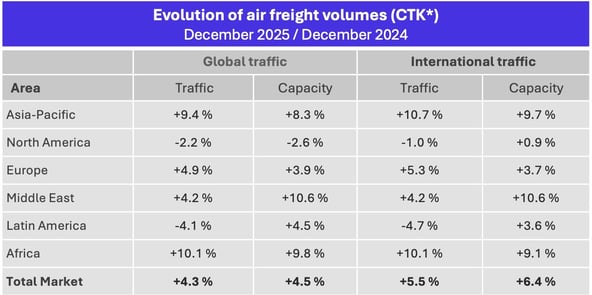
The year ended on a positive note for the air cargo sector, with overall year-on-year growth of4.3% in December 2025, and even 5.5% on international routes, according to figures from the International Air TransportAssociation (IATA). Seasonally adjusted volumes increased at the same rate.
*CTK: cargo tonne-kilometres - Data source: IATA.
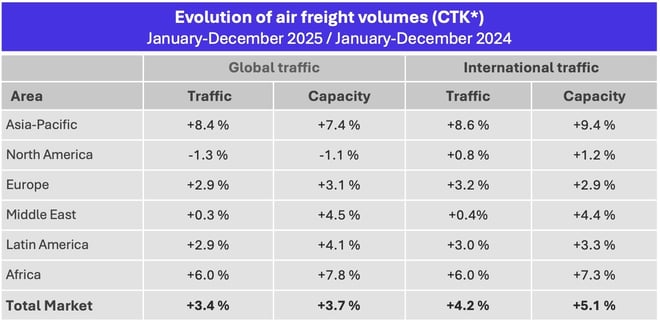
For the whole of 2025, global demand for air cargo, measured in tonne-kilometres, as such, has recorded an overall growth of 3.4% compared to 2024, and an increase of 4.2% on international routes alone. The share of the international segment in total air cargo thus increased by 0.6 percentage points. “Rather than reflecting abroad-based trade surge, growth remained selective, anchored in e-commerce, supply-chain reconfiguration, and a continued preference for time-critical transport, factors," IATA notes. The sector also benefited from the new US policy of a hike in tariffs, which prompted companies to frontload orders before the introduction of these additional tariffs, particularly in the first half of the year.
*CTK: cargo tonne-kilometres - Data source: IATA.
Up 3.7%, supply continued to grow slightly faster than demand. But the difference is small enough not to alter the market balance. The occupancy rate decreased by only 0.1 points, settling at 45.7%. On international connections, the decline is slightly more pronounced, as it lost 0.4 percentage points, falling to 50.8%.
→ The increase in capacity is fuelled by the development of airline passenger networks, which mechanically increases the cargo supply available in the bellyholds of passenger aircraft. Cargo aircraft still represent the majority of supply with nearly 58% of capacity deployed in 2025, but their share has decreased by 1.6 percentage points compared to 2024. We are thus gradually approaching the balance that prevailed before Covid, as companies restore their passenger flight network.
→ Another significant change occurred in 2025: a clear start to the redeployment of all-cargo capacity. "Dedicated freighter capacity followed a more uneven path, shaped by corridor-level adjustments rather than a uniform pullback," IATA points out. Over the course of the year, the reallocation became more evident: Europe-Asia emerged as the main driver of cargo growth, with an increase of 14.7% compared to 2024, while Asia-North America experienced a contraction of 2.6%, reflecting the exposure of this route tochanges in trade policy.
2/ The impact of supply chain reconfiguration
This reallocation of capacity is obviously linked to a trend that is becoming structural: there configuration of global supply chains with a view to reducing exposure to risk, particularly geopolitical risk.
- A shift in flows towards the European market
By 2025, the new US trade policy had profoundly affected commerce between Asia and the United States. On the Asia-North America route, demand increased slightly at the end of the year (+1.8% in November and +0.6% in December year-on-year), but this was not enough to compensate for the strong volatility observed at the beginning of the year, when the US administration launched its tariff offensive. As a result, annual demand has declined by 0.8% in 2025. “The route experienced contraction in 7 out of 12 months, with declines ranging from -0.7% to a pronounced -10.4% in May, reflecting the combined effects of tariff measures and the removal of the U.S. de-minimis exemption for shipments valued under USD 800. These pressures drove a 1.2 percentage-point loss in market share, leaving Asia–North America at 23.4% of global international demand, underscoring how policy-driven disruptions can reshape corridor relevance”, said IATA.
The communicating vessel effect was felt on the Europe-Asia corridor, which recorded a 12.2%year-on-year increase in volumes in December, its best performance for that month since 2016. Overall, annual volumes increased by 10.3% compared to 2024, "consolidating the route’s role as a core artery for manufacturing inputs, high-value goods, and time-critical shipments," IATA states. The Europe-Asia route thus represented 21.5% of global demand for international air cargo, gaining 1.1 percentage points compared to 2024.
The year was also marked by a very good performance on intra-Asian routes. Demand jumped 13.6%year-on-year in December, and 10.3% for the whole of 2025. This can be seen as a reflection of a sourcing diversification strategy on the part of companies concerned with reducing their dependence on China, but also as a symptom of a diversification of Chinese companies that are expanding their networks of suppliers and customers across the region. This dynamic is reflected in the results of the airlines. By 2025, Asian companies were the ones that recorded the highest growth rate in volume.
- More moderate or even negative growth on the other corridors
→ The Europe-North America route grew by 5.9% year-on-year in December, contributing to a 6.8% expansion for the whole of 2025, supported by stable transatlantic trade.
→ The Middle East-Asia corridor saw growth of 9.5% in December and a resulting 5.8% annual growth in demand, reflecting the Middle East's role as a logistics bridge between Asian production centres and downstream markets.
→ Demand from Europe and the Middle East remained broadly stable in December, concluding a difficult year as this route experienced 9 months of contraction out of 12. Overall, the decline in volumes reached 3.4% in 2025. This situation has weighed on the results of Middle Eastern companies, which have experienced very weak traffic growth while capacity has increased very significantly.
3/ Price trends
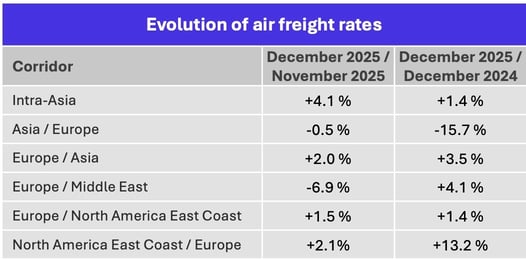
In December, yields fell by 2.6% year-on-year. This is the eighth consecutive month of annual contraction, while the level remains practically stable on a month-on-month basis, with an increase of 0.4%.
Source : Upply
Over the whole of 2025, unit revenues were on average 1.5% lower than those of 2024, which represents the third consecutive year of decline. The average yield was $2.44/kg, its lowest level since 2019 (...)
To read more and get the full article in PDF format, please enter your details.