After an already record-breaking October, global air cargo continued its positive momentum in November 2025. The sector had a satisfactory peak season, which had a positive impact on prices, but the reconfiguration of flows is confirmed.
1/ The evolution of supply and demand
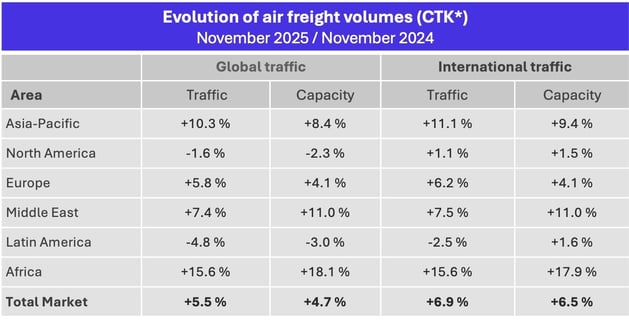
Global demand for air cargo, measured in tonne-kilometres, increased by 5.5% in November 2025 compared to the same period in 2024, reaching a new all-time high for a November, according to the International Air Transport Association (IATA). International traffic shows even stronger growth (+6.9%), confirming the resilience of trade in high value-added goods at the end of the year.
According to the figures from WorldACD the upward trend continued during the first week of December, with growth of around 5%, before a decline began during the second week. Overall, the air cargo industry has registered a fairly satisfactory 4th quarter, and a higher peak season than was anticipated in September.
* CTK: cargo tonne-kilometres - Data source: IATA.
On major global routes, all main connections returned to growth in November.
→ The Europe-Asia corridor shows a year-on-year increase of 11.7%, confirming the rerouting of Asian flows towards the European market. Year-to-date growth at the end of November is close to 10%.
→ The Europe-North America corridor is accelerating significantly (+5.0%).
→ The trend is returning to an increase again on the Asia-North America route (+1.8%) after six months of decline.
→ Intra-Asian flows also stand out, with very dynamic growth of 15.8% in November and 9.2% year-to-date.
These developments highlight a globally resilient environment for air cargo. Flows from Asia clearly remain the driving force for growth, but with contrasting performances towards the United States and Europe. Two main trends can be identified:
→ Diversification of US supply sources in Asia
→ A reorientation of flows from China towards Europe
According to data from WorldACD, "tonnages from Asia Pacific to the US were up by around +6%, YoY, in November, but most of that was generated by growth from Southeast Asia origins to the US, whereas there were decreases from China & Hong Kong (CN/HK), Japan, and South Korea to the US." The Dutch company sees this as something "that reflects a clear pattern among US importers to source products from alternative production markets in Asia in response to increases in tariffs on US imports from China and the removal of ‘de minimis’ exemptions”.
Moreover, the figures clearly reflect the reorientation of Chinese exports towards Europe, as the American market closes. "For example, combined tonnages from CN/HK to Europe were up by +8% in November, YoY, directly contrasting with the -8% drop from CN/HK to the US", says WorldACD. American customs policy therefore has a very direct impact on the air cargo industry.
- Annual totals as of the end of November 2025
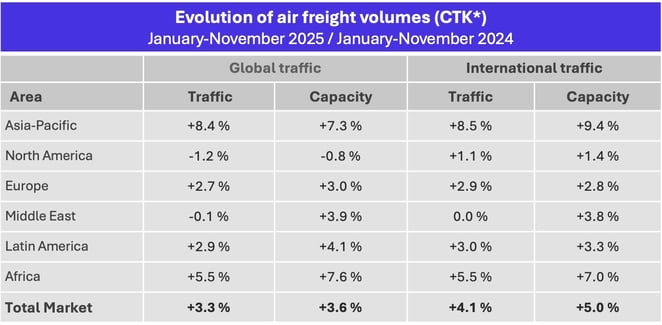
On a year-to-date basis for the period from January to November 2025, global demand is up 3.3% and international traffic is up 4.1%.
* CTK: cargo tonne-kilometres - Data source: IATA.
Supply continues to grow, but at a slower rate than demand. In November, global capacity increased by 4.7% year-on-year, resulting in an improved load factor, up 0.4 points to 49.1%.
Year-to-date as of the end of November, aircraft belly cargo holds represent 54% of the capacity offered on international routes, compared to 53.8% in 2024. In November, when the airlines' winter program was being rolled out, belly cargo capacity saw particularly strong growth, increasing by 6.3% year-on-year. The capacity available on board all-cargo aircraft also increased by 6.6%, but their share declined slightly (46%), "illustrating a gradual rebalancing towards a market structure closer to the pre-health crisis," notes IATA.
2/ Price trends
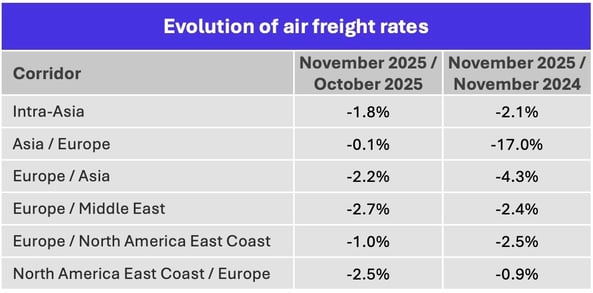
In terms of pricing, the pressure remains visible. According to IATA, average unit revenue remains below 2024 levels for the 7th consecutive month. It fell 2.9 % year-on-year to $2.65/kg in November. On a month-on-month basis, Upply data shows a moderate decline on the main routes. Despite the rebound in demand during the peak season, capacity remains sufficient to meet demand.
Source : Upply Freight Index
According to data from WorldACD, average global spot prices started to fall again during the second half of December, with the end-of-year peak now over.
3/ Outlook
Global macroeconomic indicators remain broadly favourable in the short term. In November, the global manufacturing PMI reached 51.17, confirming a 4e consecutive month of expansion in industrial activity. However, the index of new export orders remains below the 50 threshold for the 7th consecutive month, signalling a persistent reticence among businesses.
The outlook for the air cargo industry at the start of 2026 appears mixed. The sector should be able to continue to benefit from good momentum in certain key markets, such as electronic and high-tech products, pharmaceutical products and especially cross-border e-commerce.
On the other hand, trade is suffering from increased geopolitical confrontation between major economic powers. From import restrictions to tariffs, states are now using an arsenal that can have very significant consequences on volumes, creating uncertainty for air transport players. This was clearly seen in 2025 with the new US customs policy towards China, which caused volumes to plummet. For now, Europe has not seriously addressed its trade imbalance with China, but the pressure is increasing. The European Council has thus announced the application of a €3 tax on parcels under €150 entering the European territory, starting from 1er July 2026, a few months after the United States eliminated de minimis exemptions on packages valued at less than $800. This measure, which targets e-commerce, is not insignificant for air freight.
The key to success will remain the overall level of demand, which remains very uncertain at this stage, because here too, household spending and business investment will depend on the global climate and for now, uncertainties are leading to caution and making savings. The pace of restocking between mid-January and mid-February 2026 before the Chinese New Year and factory closures in China will be an initial indicator.
Overall, according to estimates published in December 2025, IATA forecasts a slowdown in volume growth in 2026. This will amount to 2.6%, compared to 3.1% in 2025. Meanwhile, revenue is expected to increase by 1.9%, from $155 billion to $158 billion. IATA finally anticipates a further erosion of 0.5% in unit revenue, similar to that of 2025.