Global air cargo started 2026 on a dynamic note. In early March, the conflict in the Middle East disrupted flows and drove up prices, but the air cargo industry is showing strong adaptability.
1/ The evolution of supply and demand
The air cargo sector has had a rather dynamic start to the year: volumes increased by 5.6% in January 2026 year-on-year, and by 7.2% on international routes, according to figures from the International Air Transport Association (IATA). Available capacity, expressed in tonne-kilometres, increased by 3.6%, marking a slowdown in supply growth. Nevertheless, with a supply of 49.7 billion tonne-kilometres, the air cargo industry reached its highest level ever recorded for a January. All regions contributed to the increase in capacity, with the exception of North America, where supply decreased by 0.2%.
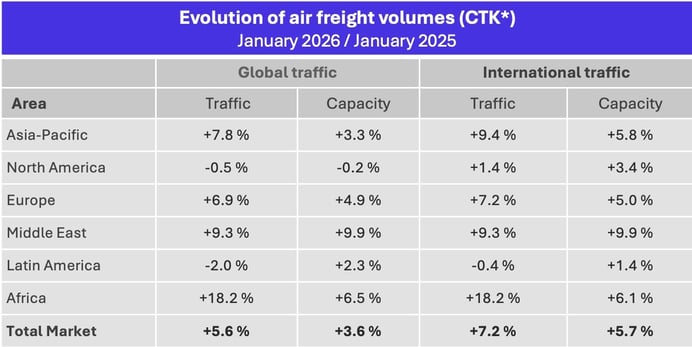
* CTK: cargo tonne-kilometres - Data source: IATA.
Global air cargo tonnage then fell in mid-February due to the Lunar New Year holidays in China and much of East and Southeast Asia. According to WorldACD data, the chargeable weight decreased by about 20% during the second and third weeks of February, after having increased during the previous six weeks. However, this decline was expected since it occurs every year at the same time, and overall, the sector recorded a 7% increase in chargeable weight in February. With the exception of Europe (-3%), tonnage increased in all regions, with a particularly strong 14% increase in volume in Asia-Pacific, WorldACD points out.
2/ The impact of the conflict in the Middle East
This good start is, however, overshadowed by more gloomy prospects. The hardest blow to the air cargo industry is obviously the outbreak of the conflict in the Middle East. The American and Israeli military strikes against Iran and Iran's response initially had immediate operational effects:
→ Several airports in the Middle East have been closed, including important hubs such as Dubai, Doha and Abu Dhabi. The first two, in particular, occupy respectively the 8th and 12th place in the world ranking of cargo airports and are major transshipment platforms.
→ The fleets of airlines based in the region have been grounded, "which stranded almost half of the capacity with origin Middle East & South Asia", according to estimates by World ACD. The gulf airlines, Qatar Airways and Emirates Skycargo are among the three largest cargo carriers in the world in terms of capacity and together with Etihad account for approximately 13% of global capacity.
→ Global airlines have suspended flights to the region and are therefore no longer accepting bookings.
The conflict in the Middle East has a major impact on Asia/Middle East and Europe/Middle East flows. But it also very significantly affects the Asia-Europe route, the second largest global corridor after the transpacific route. According to Marco Bloemen, managing director of the consulting firm Aevean, who was speaking at the IATA World Air Freight Symposium (WCS) in Peru, Carriers have adapted by increasing their direct capacity by 26% between China/Hong Kong and Europe compared to the period immediately preceding the start of the strikes, and by 14% between China/Hong Kong and Europe via a stopover outside the Gulf.
The situation is evolving rapidly, but it is already clear that these disruptions will have a significant impact on air cargo flows and on the results for March for airlines and air freight forwarders.
The conflict in the Middle East undoubtedly poses major operational challenges to airlines, but it can also be a source of opportunities. Maritime traffic through the Strait of Hormuz is now almost paralysed. Not all flows are transferable, far from it, but during the presentation of his group's annual results, Stefan Paul, CEO of Kuehne+Nagel, nevertheless stressed that there could be a transfer from maritime transport to air transport in order to bypass maritime bottlenecks.
Beyond the immediate effects, this conflict opens up a new period of great uncertainty. Operational organisation remains unstable and the war is causing a surge in oil prices which is impacting the costs of airlines. On the other hand, the risk of the conflict becoming bogged down poses a threat of a slowdown in the global economy, during a period where the outlook was already not a rosy one, and this could alter the volume of global trade.
3/ Price trends
In January, global aviation fuel prices began the year at US$90.3, down 6.5% year-on-year. This dynamic contributed to the downward trend in average unit revenue. It fell by 0.8% year-on-year, marking a ninth consecutive annual contraction, and by 8.3% month-on-month, according to IATA data. February also proved to be rather quiet, as cargo from Asia experienced a lull linked to the Lunar New Year.
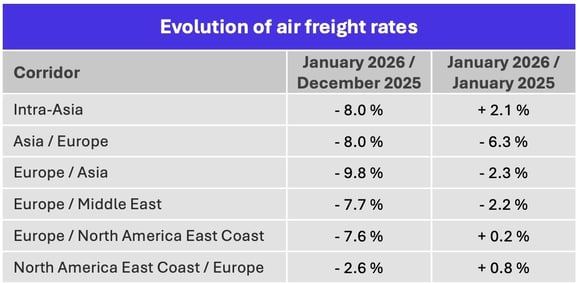
Source : Upply
However, the conflict in the Middle East has changed everything. The data from the Freightos Air Index show that air cargo rates between South Asia and North America and Europe, have increased by about 50% since the start of the war, reaching about $6.00/kg and $4.00/kg respectively. Prices between Southeast Asia and Europe have risen by 20% to exceed $4.00/kg. Furthermore, tariffs between China and the United States also climbed 20% to exceed $7.00/kg, but this increase is largely due to the recovery in demand after the Lunar New Year.
4/ Outlook
While the conflict in Iran now takes centre stage, air cargo is exposed to many other geopolitical hazards, starting with tariffs. On this front too, there is great instability.
In a decision made public on February 20, 2026, the Supreme Court invalidated part of the US tariffs decided by Donald Trump in 2025. It considered that the use of the International Emergency Economic Powers Act (IEEPA) to impose these tariff measures was not legal. The American president immediately retaliated by announcing the imposition of new tariffs on a different legal basis. section 122 of Trade Act of 1974, which authorises him to impose customs duties of up to 15% for a maximum period of 150 days.
According to the analysis by Global Trade Alert China, India, Vietnam, Brazil, and Indonesia are those most favoured by the new US customs situation. These countries would all have seen their effective customs duties fall by more than ten percentage points. American importers may therefore be tempted to frontload their orders again, but probably to a much lesser extent than in 2025. The impact will also be much more mitigated on the transatlantic market.
While the Supreme Court's decision is to some extent good news, as some operators have indicated that they intend to claim the sums unduly collected, it also opens a new period of uncertainty. It is difficult to anticipate the measures that will be put in place by the Trump administration at the end of the 150 days stipulated by the Trade Act. This foreshadows upheavals which, as always, have a dual effect on the air cargo industry: sudden changes in demand that are complicated to manage from an operational point of view, but opportunities for this mode of transport which is capable of responding quickly to needs.
The cross-border e-commerce sector is now one of the main drivers of growth in air cargo. Some clouds have appeared to darken the horizon though, but they are more indicative of a new structuring of flows than of decline.
In the United States, the elimination of duty-free access to packages valued at less than $800, which was not challenged by the Supreme Court, immediately led to a decrease in volumes, which were diverted in particular to Europe.
Europe is therefore beginning its own response to the onslaught of Chinese products, which is gaining even more momentum as the American market closes up. This is the case, for example, in the e-commerce sector. The European Union provides for the elimination of the de minimis customs duty exemption on shipments under 150 euros and the introduction of a flat customs duty of €3 per item from 1st July 2026.
Furthermore, France has decided to introduce a temporary tax of €2 per item, starting from the 1st March 2026. This "small parcel tax" applies to parcels of a value of less than 150 euros, coming from countries outside the European Union and destined for metropolitan France, Monaco, La Réunion, Martinique and Guadeloupe. The Ministry of Economy specifies that the tax will be applicable "until the entry into force of the similar management fee system which should be deployed at an EU level in November 2026", recalling that this is a separate mechanism from the abolition of the customs duty exemption.
Faced with these American and European measures, the main Chinese platforms are already restructuring their supply chains. Last December, Shein opened a store in Wroclaw, Poland, a new European logistics hub, whose storage capacity will reach 740,000 m² when it is running at full capacity.
While the outlook for global trade is weakened by geopolitical uncertainties, the air cargo sector should continue to thrive. This is partly because it can serve as a backup in the event of sudden disruptions to supply chains, and partly because the industry can rely on promising sectors such as semiconductors and pharmaceuticals. Air cargo operators will need to be agile, but they also have some tricks up their sleeve to take advantage of the unstable situation.