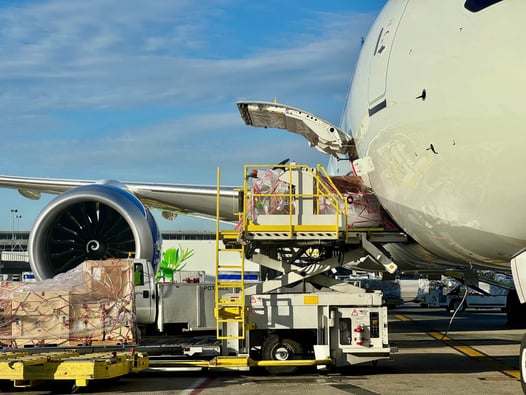
SPECIAL FEATURE 5/5. Air cargo is a strategic element for the Dutch economy, which is geared towards international trade. With Amsterdam-Schiphol Airport and the airline KLM/Martinair, the Netherlands has major operators, but they are subject to a competitive environment.
Maritime transport accounts for the vast majority of international cargo flows to and from the Netherlands, which is notably home to Rotterdam, the leading European port for container traffic. Nevertheless, air cargo is a strategic activity for a nation that has based its economic prosperity on international trade and connectivity.
Strong competition within Benelux
Since the beginning of the 2000s, the cumulative traffic of Dutch airports has remained relatively stable, fluctuating around 1.5 million tonnes. However, the evolution over 10 years shows structural erosion. While it long held the 3rd spot in Europe, behind Germany and France, the Dutch airport ecosystem is now facing strong competition from its Belgian neighbour.
- The Covid-19 Turning Point
Between 2016 and 2019, Dutch airports handled approximately 1.8 million tonnes per year. Traffic then fell to 1.6 Mt in 2020, the year the Covid-19 pandemic began, before rebounding to 1.8 Mt during the post-Covid recovery period. But since then, cargo traffic has declined again and has not returned to pre-pandemic levels. Between 2022 and 2025, the average annual traffic was 1.4 Mt, which is 15.2% less than during the period 2016-2019[1].
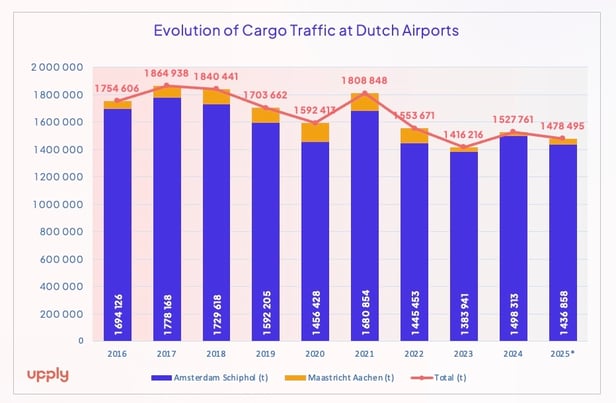
Source : CBS
The Dutch market faces strong competition from Belgian airports, which are at the same time experiencing a spectacularly powerful upswing. According to data published by the Belgian federal administration, average annual traffic increased by 36.2% in Belgium, rising from 1.3 Mt during the period 2016-2019 to 1.8 Mt during the period 2022-2025.
Unlike the Netherlands, which relies almost exclusively on Amsterdam airport, Belgium has been able to count not only on the upswing in Brussels, but especially that of Liège. In ten years, traffic has more than doubled at Liège airport, which has notably captured significant traffic related to the development of cross-border e-commerce between China and Europe.
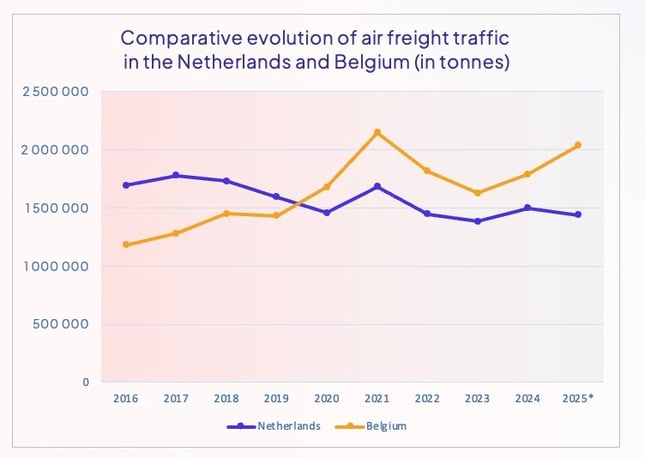
Source : CBS (Netherlands), SPF (Belgium)
Traffic concentrated on Amsterdam-Schiphol
In the Netherlands, 98% of air cargo passes through Amsterdam-Schiphol. With a total of 1,436,858 tonnes handled, and despite a 4.1% year-on-year decrease, the hub maintained its 3rd place ranking in 2025. Liège airport is also aiming for a spot on the podium of European Union airports.
Amsterdam-Schiphol has a major advantage: it is home to the headquarters of KLM/Martinair, a major player in European air cargo. Since the merger of Air France and KLM in 2004, and then the integration of Martinair in 2008, the group has been utilising the complementarity of the three airlines and its two hubs at Charles-de-Gaulle and Amsterdam-Schiphol. In 2025, the group recorded cargo traffic of 6,920 million tonne-kilometres transported, up 1.3%, of which 3,145 million tkm was for KLM-Martinair (-7.2% compared to 2024).
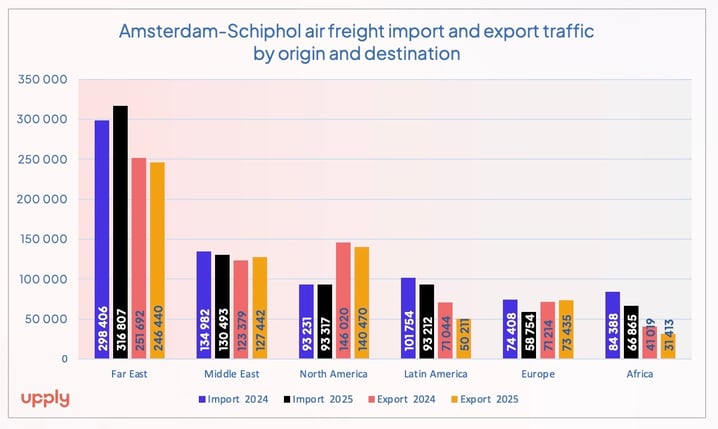
For Amsterdam-Schiphol Airport, flows with Asia occupy a predominant place, both in import and export, with a fairly marked imbalance in favour of import, which reflects the structure of international trade. The flows with the Middle East, in second place, are on the other hand quite balanced. In trade with the United States, exports dominate, but their decline of 3.8% in 2025 and a stagnation in imports, were a direct consequence of the increase in customs tariffs by the new American administration.
Source : Amsterdam-Schiphol Airport
- Increased environmental constraints
Although Amsterdam Airport benefits from a solid foundation with the presence of the Air France-KLM group, it must, on the other hand, contend with increasing environmental pressures which do not facilitate the development of cargo activity. This may also partly explain the lag compared to Belgian platforms.
⇒ The Dutch government had set a ceiling of 478,000 annual movements (down from 500,000 previously), which came into effect on November 1, 2025. The Dutch Council of State overturned this cap on March 11, 2026, finding that the government had not sufficiently justified its legal basis. But the pressure remains.
⇒ The noisiest aircraft (including the Boeing 747-400, widely used in the cargo sector) have been banned between 11 p.m. and 7 a.m. since November 2025. In the longer term, Schiphol plans a complete night closure (0am-6am for takeoffs, 0am-5am for landings), meaning approximately 10,000 night flights cancelled per year — a measure that would also apply to cargo.
⇒ Since April 2025, airport charges have been adjusted according to the noise level of aircraft. The noisiest aircraft pay more, which penalises part of the cargo fleet.
- The Ambitions of Maastricht
At the end of 2024, the Maastricht airport authorities announced a strategic pivot towards air cargo, with a "long-term" target of 200,000 tonnes annually. This is equivalent to multiplying traffic by five, since in 2025, 41,636 tonnes of cargo were processed (+46.3% compared to 2024). For now, the platform is highly specialised in perishable cargo: vegetables, fruits and flowers.
The very constrained environment in which Schiphol operates could help Maastricht Airport realise its ambitions in the cargo sector, by pushing companies to reposition flights to Maastricht. In 2023, the airport began renovating the runway and invested 70 million euros in modernising its cargo facilities. In early 2026, it submitted an application for a new operating license that would allow full use of its 2,750-metre runway, whereas the current license only allows the use of 2,500 meters. This would allow cargo planes to take off with more payload and/or to more distant destinations, which is a key element in attracting long-haul operators.
This development is not an action carried out against Schiphol but rather in coordination with it. In 2023, the two airports launched a strategic cooperation, which gave rise to the Schiphol Group acquiring a 40% stake in Maastricht Aachen Airport, with the remainder held by the province of Limburg.
[1] We chose to calculate the 4-year averages before and after 2020-2021, years marked by exceptional developments linked to the Covid-19 pandemic.